


 The 19th Wife by David Ebershoffl

NPR Interview with David Ebershoff
 The Sugar Queen by Sarah Addison Allen

This was a great surprise. Addison is an author from North Carolina, and the book shows it with the imagery and dialogue. I’ve read a couple of North Carolina authors and really enjoy the vibe. This book chronicles the breakthrough of a late-twenty something late-bloomer who is trying to get out from under her mother’s control. She hides food in her closet as her form of rebellion, and one day she finds a local woman hiding from her new boyfriend in her closet . This woman ends up changing her life and helping her find her own strength.
 The Last Wish by Andrzej Sapkowski
 The Aquariums of Pyongyang: Ten Years in the North Korean Gulag
 The Sea of Monsters
Book 2 in the Percy Jackson series.

 Give us a two sentence teaser from your current read.
The Aquariums of Pyongyang: Ten Years in the North Korean Gulag
“The feeling of being isolated in the very place where I lived, to the point of not knowing who else was there or even where the camp was located, seemed particularly inhumane. It wasn’t just a way of keeping me in the dark about where I was, it was a means of attaching my identity.” Pg. 78
Hosted Should Be Reading.
My three day weekends are dwindling. I’m fairly certain that the wonderful four day work week was just my prize for being one of the “newbies,” and that in two weeks I’ll be back to a five or six day work week. It has been great to have to have long weekends to explore Korea, and this weekend we took the bike out again and headed to the nearby Ganghwa Island. Ganghwa, and several of its neighboring islands are all part of the Metropolitan City of Incheon, even though like Buypeong, they have their own city offices as well. I’m not clear on how municipalities work here.
Ganghwa and Seokmo Islands make great day trips. There is a lot of cultural stuff to be seen, and true to seaside towns everywhere, there is a certain relaxed air along with the cool breeze.
The north side of Ganghwa island is spotted with dolmens, archaeological features made out of gigantic rocks stacked in various shapes. The most common in this area are table dolmens, two to four large rocks form a foundation, and a huge cap stone is placed on top. These rocks cover underground burials.
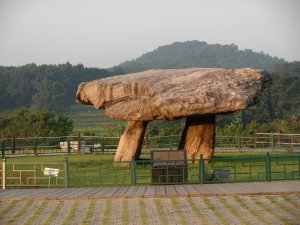
Table Dolmen
We took a road around the island, and headed south. The island is dotted with military checkpoints, and at one point we took a wrong turn, the soldiers quickly turned us around, looked at our map like they’d never seen one before, and pointed us in a vaguely different direction.
We ended up at Oepo, which we didn’t realize until the next day. Everytime we showed someone our map, first they acted really confused as to how or why we didn’t know where we were, and then they would flip through the atlas looking for something familiar, but it became pretty clear that map reading is not something many folks are exposed to here. I suppose that’s true just about everywhere, especially in places where people tend to lead fairly localized lives.
Oepo is a sea town famous for it’s raw fish restaurants. Neither Jim or I are really big on that, but I talked Jim into being more adventurous about food and we picked one. After much gesturing and getting nowhere, the waiter finally just dragged us over to the fish tank and motioned for us to pick one. There were conchs, which we tried one, flat brown spotted fish, and then regular looking long chubby fish. We tried on of those, having no idea if it was going to be cooked, prepared, or just served whole on a platter. Here’s what came out first:
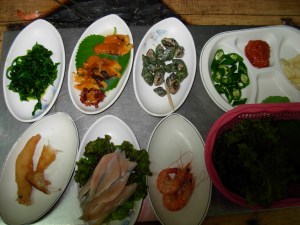
Side dishes at the raw fish market
A seaweed salad, the conch – which was really weird, slimy, salty and slightly bitter, some sort of snail that tasted like clams and we had to fish them out of the shell with toothpicks, the ever-present side of peppers, garlic, and chili sauce, fried shrimp (complete with shells and heads), a fillet of small relatively tasteless fish, some cooked whole shrimp, and basket of greens.
The fish we ordered came out raw on a pile of clear “noodles” cut into delicate little pieces with side of slightly different chili sauce.
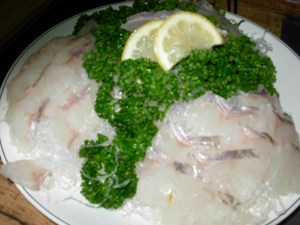 It was really good, and then a soup with the head and the tail of the fish in it was brought out. The soup was fantastic, but really, really spicy. We managed to avoid the head of the fish, I never knew that fish eyeballs turn completely white when boiled, until the waitress came out and cut up the head with a pair of scissors, releasing the bones, scales and who knows what else into the broth. It was kind of sad.
Unfortunately, I felt like most everything except our large fish tasted vagely of dirty ocean water, but we got out of the culinary adventure relatively unscathed.
The next morning we hopped a ferry to Seokmo Island, where the very famous Bomunsa temple is nestled on a cliff-side of one of the interior mountains. It was a lovely area, with a huge, gorgeous temple. It was the hottest I’ve felt yet this summer, but the place was still teeming with people.
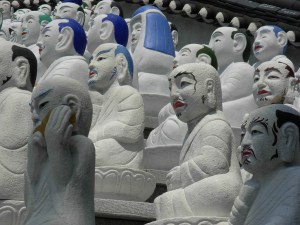
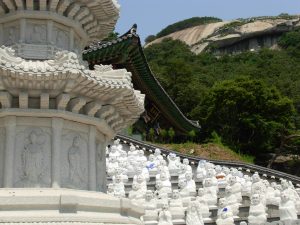 It is a holy site that has several components that have all been combined into one temple. There is a cave temple that was built around the year 635. I didn’t get a good shot of it, but in this shot from above the cave looking down on the buildings you can see the top of the rock that is the temple. Cave temples are one of the things I am really interested in regarding Mongolian archaeology. Buddhism has been persecuted many times as a religion, particularly in North Eastern Asia. In Korea many of the monks took refuge in the mountains and in Mongolia they went into hiding in caves. This part of Korea used to be the capitol of the country, and was invaded by Mongols in the mid 1200s.


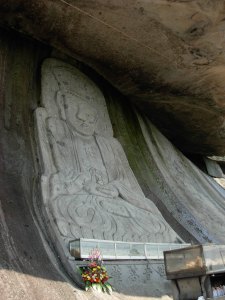
Also at this site is a 32 foot carving on a cliff face of Buddha constructed in 1928. It was a difficult and really hot climb up the side of the mountain, but we got to talk with some students whose parents were eager to have the money they spent on English lessons put to use. We talked for a while with a college student who gave us some information on the area and was really friendly, until it became clear his father was upset his son was spending time talking to us instead of praying.
Hot and exhausted we caught the ferry back to Ganghwa and did a tour around the south end of the island, which was a huge mistake. There was an enormous sea of people going to the beach that day, and between people trying to park along the road and all the folks walking, it was impossible to get anywhere. The beach wasn’t a sandy beach like we think of it, it was low tide, and a giant mud flat where people were digging for shellfish, rolling around in the healthy benefits of sea mud, and generally getting sun baked. Who needs mudfest? Folks can come to the beaches and get covered in mud anytime.
We finally made it through and made a pit stop at one more temple before riding home. I was so tired at this point, even I couldn’t find much to be excited about. Jeondeungsa temple seemed very new to me, and in fact several new temple buildings were under construction. People were buying slate roof tiles and writing things on them that I assume where going to be blessed and then used on the roofs of the new buildings.
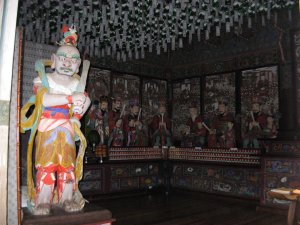
I did like this temple that had “guards” in the doors. I wasn’t sure if they were there to keep evil spirits out, or to bonk lazy practitioners such as myself on the head as people walk in.
We finally headed back to the Incheon mainland, feeling culturally fulfilled. We got quite lost, and a really generous Korean man in a car saw us scratching our heads and looking at street signs. He was trying to give us directions, but then just decided to go out of his way and drive us to the intersection we needed. It was such a great ending to the day to have someone go so much out of their way.
As we were following him, we noticed he was driving a Ford.
Unless you teach at one of the S. Korean schools that is mandating quarantine for everyone who leaves the country, you probably thought you were done hearing about “the Quarantine.”
Sage Tyrtle from the Canadian podcast Quirky Nomads contacted me about doing an interview and I had a great time talking with her about our time in the swine flu madness lockdown. As much as it was up and down while in it, everyone was right, it does make an interesting story to tell.
I think her hook-line for the story is fantastic: “When Shanna Underwood of Ruby Ramblings and her friend Jim were laid off at the same time, they decided to go to Korea and work as English teachers for a year. A week after arriving, Shanna was woken up at four in the morning by a knock at her hotel room door.”
Quirky Nomads has a lending group on Kiva if anyone is interested.
Jim’s grandfather was stationed in South Korea in the late 1940s, right before the outbreak of the Korean War. He was stationed in Yeosu, a then almost nonexistent, and now still small coastal town on the south end of Korea. I learned from a friend that Jeju Island was a stronghold of communist support, sandwiching the mainland between themselves and what is now North Korea. This may be a possible reason for why so many folks were stationed along the southern coast.
We had a long weekend away from the hagwon, and decided to take a trip south. Not just any trip, no, no, we ventured on Jim’s motorcycle all the way from Incheon. Well Jim, did anyway. He left on Friday morning, and as I had to teach Friday, I caught a bus to Gwangju.
Gwangju
Since I don’t work for a public school, and have almost no vacation time for this entire year, the unexpected opportunity to take a long weekend was too much to pass up. Being the kind of adventurer I am though, I always try to fit in too much. My original plan to meet a couple of friends in Dangjin for drinks was foiled by the fact that a huge percentage of the country also had this weekend off, which left me with no train or bus tickets to anywhere I needed to go. I was at the bus station, wondering what the hell to do, when I finally got in touch with Jim, who had been riding his motorcycle all day. He was close to Gwangju, and wonders abound, it was the only bus with any spots left that night at the terminal. I bought a ticket, checked with the guidebook since I really had no idea where Gwangju was, and settled in for a four hour bus ride that started at 11pm.
Since there was no way Jim and I were going to find each other, when I got to Gwanju, I just found a motel and passed out. When Jim called the next morning, it turned out he wasn’t that close to Gwanju, and I needed to entertain myself for a few hours. See, this is where I get myself in trouble. Open the guide book, see what there is in the area – ah, Mudeungsan Mountain, that sounds like fun. I hopped a bus in the right direction, keep an eye out for the Wonhyosa temple entrance, and I’m off.
The bus took a long route up a winding mountain, and it turned out I didn’t need to watch too closely as the Wonhyosa temple was the last stop on the bus line.


Jim called, and was still a while away, so I decided to take a walk up the mountain trail. This is where I really got in trouble. Not wearing good shoes, with a shoulder bag full of books and clothes, but the never ending desire to get a few good pics and a decent hike in, I struck out on a path that said it was headed to another temple, where supposedly I could catch another bus. All would have been well and good, except that I fell twice on my already fragile knees, making for slow hiking, and when I got 9/10ths of the way to the temple – straight downhill almost 3 miles, the trail was washed out and a giant fence was put up to prevent people from trying to scramble around. I looked up the mountain, it was physically impossible for me to get back up that mountain at this point. My knees were a mess, I had no water, and the really crappy Chinese I had for breakfast was long burned up. There was a little path to the right that was my only bet, but I didn’t have the slightest idea where it went.
Jim calls again, “I’m in Gwangju.” Well, that’s great, but I’m lost in the woods.
After much walking, slipping once again and getting chastised by an old Korean man for my poor choice in hiking foot attire, I found my way to an entrance to the park and another bus stop. As is pretty common, none of the bus stop signs were in English, so I just had to get on a bus and hope it was headed toward Gwangju. Luckily it was, and although I couldn’t figure out how to get back to the station, I was able to get into town and then take a taxi to the bus station.
On the bike, 22 to 17 south.
Yeosu
Yeosu is nothing like what it was fifty years ago. Although it is still a fishing town surrounded by rice fields and farms, it has fallen into the concrete pattern of the rest of the country. One thing that strikes me here are some of the places that food is grown. You will see corn plants right up the road, with no break or ditch like there would be at home. Squash and melon plants are spilling onto the streets and hanging off roofs where they are grown on sheets of plastic lined with dirt.


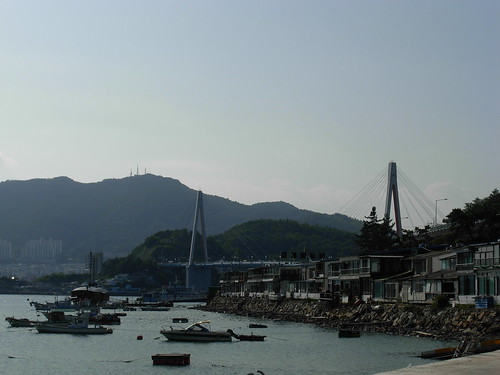
There are several islands off of Yeosu, and a road that connects them all. Well, almost. When we passed over the first bridge, I was thinking it looked suspiciously new. Sure enough, half way through the first island, and the road ends in a corn field. Development is so fast here that roads that are still “to be built” are labeled as real roads on the map, because it would be pointless to update maps every time a chunk of asphalt is put in. The geography of Korea changes constantly. A country that was once completely leveled and deforested is now 90% re-forested and covered in amazingly lush mountains top to bottom.
We turned back around and decided to try and take the road around the islands from the other direction and see if we could get any further. We pulled off onto a road that said it had a temple on it. A long, winding, partially paved, hole-filled road. At the end, it just looked like a row of dilapidated buildings. Just as we were about to pull away, a very excited woman calls out in English, “Oh please come up!!” She saw Jim’s Ohio State t-shirt and was immediately ecstatic over seeing a couple of fellow Americans. She is a Korean woman who emigrated to New York over thirty years ago, and had come back to Korea to reconnect with family and her roots.
As we came up the stairs, we could see what we couldn’t see from the road. This was indeed a giant temple, complete with retreat cabins, giant statues, and a huge temple shrine. Twenty years ago a lone monk decided he wanted to start a temple in this gorgeous location, and set out raising money on his own.
What struck me was how much the area looked like the Maine coast. Pine trees and mountains that come right up to the ocean. Some of the pics here could be confused for pics I took living in Bar Harbor.


Chong, our new Korean-American friend, went out of her way to ask the resident monk if he would mind meeting us. He invited us in for tea. This is why I came to Korea, to meet monks and hang out in temples. He was wonderfully gracious and talked to us for a couple of hours. He even gave us a meditation lesson, and gave me homework. Chong said he gave me homework because he wants to see me again. I asked if I could come back to do a retreat and he told me if I practice, I can come anytime, but if I don’t practice meditation, he will know. It was great, and one of the most beautiful places I have seen. Chong said she wasn’t even planning to come to this temple when she first came, she did like we did and just visited on a whim – and then never left. She’s been studying there for a year and plans to stay for two more.
The monk also said that if any foreigners are interested in coming as a group for a retreat, he would be really interested in teaching it, so if you are interested, we can coordinate, and I will contact them about having a group receive a teaching.

The hardest part of the trip was getting back. We made it the entire length of the country in a few hours, and then spent the same amount of time just getting from Seoul to Bucheon. It made me wish we lived somewhere like Gongju where we would be close enough to Seoul to bus in, but far enough away to enjoy the country.

The bike getting a rest from our butts, or our butts getting a rest from the bike. I’m not sure which.
Filed under: Books
July disappeared faster than a short February holiday in Bermuda. Hence, I read very little, but travelled much.
All of my reading this month was mandatory. It was either for a book club meeting, or something I owed to someone on BookObsessed.
 An Acceptable Time
 Child 44
Probably the best book I read this month. A detective during Stalinist Russian times uncovers a serial killer who is using the notion that the only violence that exists is controlled by the government to his advantage. When Leo decides to investigate, he finds himself targeted for crimes against the state.
 A Thousand Splendid Suns
I read this for the Seoul Women’s Bookclub, and I’m glad I did.
 The Lightning Thief
*Ruby looks woefully at this list.* I must have read more than that?
Filed under: economics, Korea, Peace, Politics, Travel, War | Tags: DMZ Korea
The Demilitarized Zone tour, or DMZ as it is known, was one of the more interesting things I’ve done since being in Korea on many levels: at once a cultural event, an educational event about a hotspot for violence in the world, and an interesting look into how two countries are shaping their own history and public information.
It was also a chance to be around the type of foreigners that I’ve avoided since coming to Korea – the loud ones that think the whole bus needs to be regaled with their tales of drunkenness, sexual excursions, how various penises from around the world compare, and all the things Koreans do wrong. This in turn led us to make friends with two of the very cool type of foreigners who agreed that the other type were being way too loud and ruining our view.
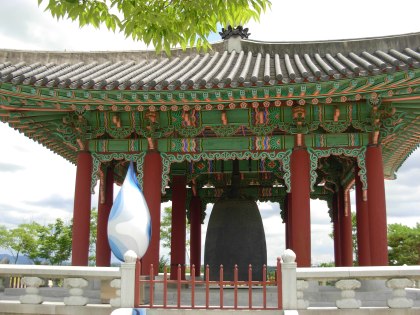
Peace Bell
For anyone back home who might not be aware, the DMZ is a swath of land bordered on both sides by a fence and razor wire, that divides North and South Korea. No one has been allowed onto this skinny piece of land that runs the entire width of the Korean peninsula for fifty years, and they claim it has become a haven for wildlife. Unfortunately, the most interesting parts of the tour were the parts we were not allowed to take pictures of.
First we stopped at Unification Park, where the fact that South Korea has turned this into a huge tourist venture is blatantly obvious. People from all over the world, including Koreans, come to the boarder in droves to glimpse a little of the insanity that is North Korea, and also to pay homage to the fact that eventually they may be a unified country again. They’ve gone as far as to build a theme park to keep the kiddies happy, and the start of a “bridge” that may one day join the two countries – an enormous steel structure that at the moment is truly a bridge to nowhere.

The North Korean border is family friendly!
Our first stop after joining the larger tour was the Third Infiltration Tunnel. This was truly fascinating, and unfortunately we couldn’t take pics in the inside of the tunnel. South Korea has found four tunnels, the latest in 1990, that are assumed to built by NK to be used to tunnel in ground support for an air strike on South Korea. They believe there may be more tunnels that have yet to be found – yet another case were geologists and archaeologists may be of help – Jim and I were talking about how if they did a survey of the border with a resistivity machine, they’d find out pretty quick if there were more tunnels or not. I had a feeling that the threat of more tunnels might actually just be being used to keep people concerned.
One of the more interesting facts about the tunnels is that the North Koreans smudged them with coal and tried to claim that they were coal mines that went too far underground and “accidentally” made it over the border. Anyone who has worked in coal country doing survey knows this is utter BS. First of all, coal exists in layers (as it is formed by compression of layers of organic material over a long period of time), which is why strip mining is so popular. You need to strip off a broad swath to get the most coal; skinny tunnels would not be effective at all. The other reason is that the area is mostly granite, not a place where coal layers are likely to be found.
It is said that the North Korean government told its people that South Korea actually built the tunnels to infiltrate North Korea and ruin their society with their filthy westernized ways. One interesting thing about the video we saw before going into the tunnels is that it makes almost no mention of the American, British, or Soviet involvement with WWII and the Korean war. It shows footage of the two different factions of Koreans, calling it a “fratricidal” war – almost implying that no one else was involved.
The closest thing I could get to a tunnel shot, was an outside shot of where the recently bored new tunnel was constructed to join with the actual Infiltration tunnel so that tourists could go down into it. It is thirty meters underground and we had to wear hardhats – this is all getting very familiar. Don’t forget your PPE! (If you don’t get it, don’t worry, it’s an inside joke.)
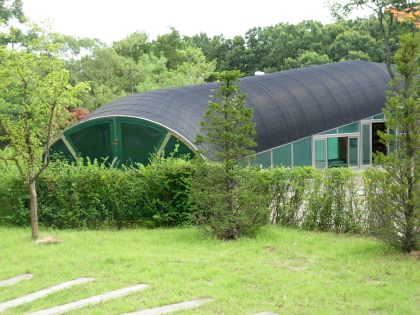
Entrance to the tourist tunnel
We moved on to the observation tower – and lucked out with having a gorgeous day with a great shot of the North Korean mountains, and a “city.” Apparently when North Korea became aware that this observation tower had been built, and tourists were coming to view this area, they promptly built a fake city to prove that North Korea is doing well and prospering. Someone comes to switch on and off the lights, but no one really lives there. You could really tell, to me it looked like one of those pre-fab midwestern towns where the Home Depot has been built, the townhouses are up, but no one has actually lived there yet. There is something so distinctive about the traces that humans leave, that I think we can really tell if no one has ever lived there even if it is made to look on the contrary. We were not allowed to take pics of this town either (or the map of the area inside the building).

You can almost see the "village", and the mountains were gorgeous.

At the observation tower overlooking the "village."
The last stop was a blatant piece of overly optimistic propaganda. With the money raised from tourism, there has been an entire subway station built right at the border, complete with destination Pyeongyang, North Korea. It claims with absolute certainty that when North Korea collapses and is once again unified with South Korea, that the train line will eventually join with the Trans-Siberian, and Trans-China lines. We were even able to use a “commemerative stamp” to stamp our tour books and prove we had been there. Scrap-booking is apparenlty alive and well everywhere. There were also large photos of when Bush came to the opening of this station, declaring his support for the unification of the peninsula.
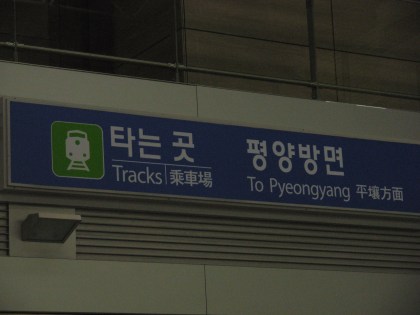
Although these are nice sentiments, is South Korea really willing to take on the financial, social, and political burden of bringing a populace of brain-washed people, who have a standard of living one hundred years behind the rest of the world, who truly believe that if you touch something western your hand could fall off, up to South Korean consumerist standards? (There was even some discussion that maybe they are looking at North Korea as a possibility for really cheap labor – a job now farmed out to Burmese, Pakastani, and Nepali folks. Using North Koreans would have the advantage of the people speaking at least some form of Korean.) There was a windowless building next to the station, that the tour guide noted that she was required to tell us was a storage unit for goods from the area. She was implying that that is not at all what it is, and more likely, I’m assuming it is probably a weapons cache or some such.
Of course there are also North Korean refugees who just really want to see their home again before they die. All along the border there were old ladies wearing pink and praying along the fences. To me they were a much bigger sign of hope than subway stations that go nowhere. At the end of the day, what people are willing to do for each other is really what matters the most.
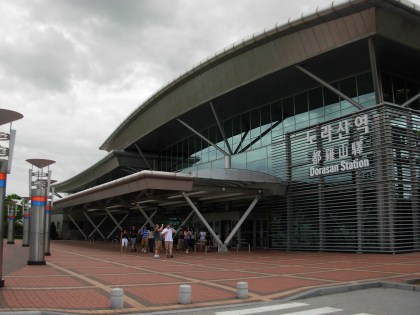
Train Station to Pyeongyang
All in all, it was a fascinating, thumbs-up day.
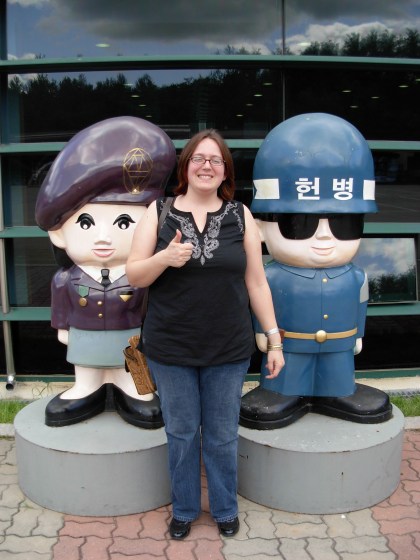
For anyone that cares, we used Grace Travel 02-332-8946. 48,000 won, but it does not take you to Pannumjeon – where the US and North Korean soldiers stand and stare at each other. We’ll save that for another time.
Filed under: Books

Open your current read, pick two lines that aren’t spoilers, share….

” The tree tops swayed in the breeze, and she imagined they were nodding their welcome to her. Mariam steadied herself against the waves of dismay passing through her.”
A Thousand Splendid Suns
I have been avoiding reading this book since it came out. Because it was picked for the Seoul Women’s Bookclub this month, I had to suck up and read it to join the discussion. (Actually I’m sure they would have welcomed me anyway, but I am somewhat interested in reading it.) I may be the only person who read The Kite Runner
I was sitting in a shop of a Pakastani friend, and we were having fun picking through all the Pashtu words mixed into the text. Although his first language is Urdu, his mother spoke Pashtu, and he found most words quite recognizable. A side note is that the word harami in this book refers to an illegitimate child, where as in his region he said it was used for men who are backstabbers.
Hosted by Should be Reading.
The monsoon rains have made my grand weekend plans difficult to maneuver lately. Unfortunately I no longer have three day weekends since I’ve taken on teaching a summer intensive. I now teach three, three-hour classes a day. I missed a “company party” – read the boss gets really drunk and tries to control and humiliate his employees – something I am trying very hard to avoid ever having to go to, but I’m sure there will be ramifications for my not making it.
My original plan had been to go to Gongju for the long weekend, but a series of events made the trip impractical for the amount of time I was going to spend, and at the very last second, another teacher and I hopped a bus to Icheon just as it was leaving. The day displayed perfectly how if you are are willing to be flexible and not hold onto expectations, the greatest travel experiences arise.
Icheon is known as the ceramic city (not to be confused with Incheon, the part of Korea that I live in – Bupyeong to be exact), but except for the kimchi pots along the unbeaten path, we didn’t spend much time looking at the local wares. It was pouring rain, and determined not to let that ruin our day, we got off the bus and headed to a Vietnamese restaurant called Pho Tai. It was excellent – we had some noodles similar to pad see ew, and a pork pho soup that was fantastic. The rain let up and we decided to taxi it up to a temple that I was interested in seeing. Of course it started pouring again once we got in the cab, all the way to the temple. The cab driver gave us his number, and even offered to wait a few minutes while we took pictures, but we were determined to make this more than a ten minute trip. Our luck was with us, and it stopped raining soon after he dropped us off in a field full of louts blossoms and white cranes.
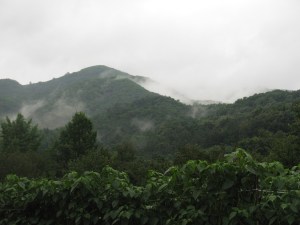
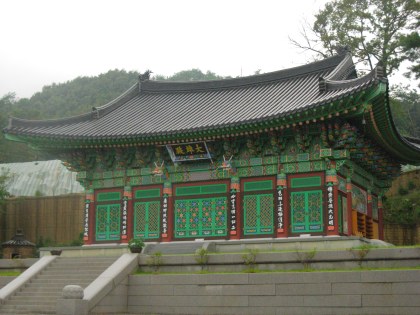
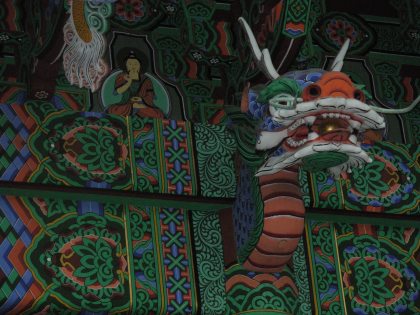 After hanging out under the awnings waiting for the rain to stop, we started walking up the hill. The regular road ended in a worn path through the woods and up the mountain. “I’m game if you are game,” we said to each other, and were off into the first place in Korea I have seen where we didn’t encounter a car, another person, or a house constructed from concrete for hours. The hillside had cemeteries, some older, and some quite new, every few hundred meters. Unlike most places in the US, where we write off slope as an improbable place for archaeological finds, all the cemeteries here on sometimes quite steep hillsides, with berms of earth built up around them.
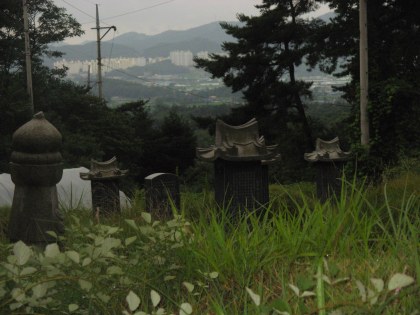
Cemetery
We walked up the mountain for a while and started to see the tell tale signs that there was a temple ahead. Primarily the plastic, painted lanterns strung through the trees.
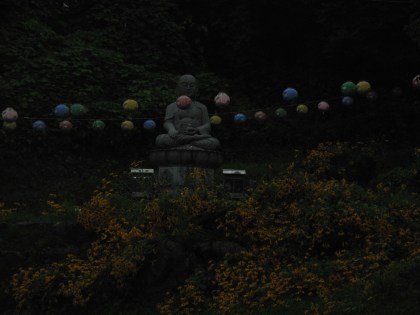
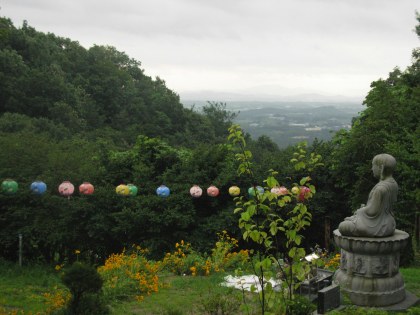
We came up around the temple, and came into the temple garden from the top. I noticed that one statue seemed out of place and not in keeping with the style or texture of most statues I have seen at temples. When I came around to the front, I could see that it was, indeed, a peeing fountain.
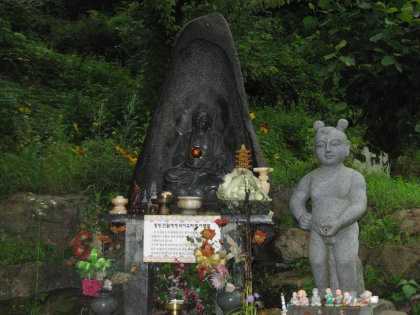
Peeing boy and Buddha.
We had a decision to make, keep heading up the mountain, or go back the way we came and call the taxi. We went for up. The weather was holding out, somehow we weren’t suffering from the exhaustion that overtakes me on even short subway rides to Seoul, and the excitement of travelling with someone who is agreeable to taking the unconventional path was too much fun. We took several paths around the mountain that ended in dead ends, waterfalls (unfortunately covered in trash, it seemed society’s mark had found its way onto the mountain), and one precarious river crossing where the road had washed out.
Making our way back down the other side we came to a peculiar coffee shop in the middle of nowhere. Called the Station Cafe, it came complete with the sounds of the proprietor playing jazz saxophone.
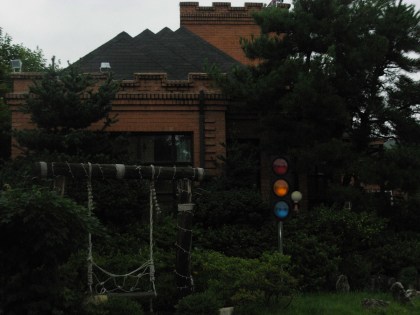
After a lovely cup of pine nut tea, we called the taxi to come take us back to the bus stop. When we pulled away from the coffee shop we could see that it was actually right next to the field we had been dropped off at. We had made a perfect circle around the mountain.
Since my weekend plans got delayed due to the monsoon rains, I’m hanging out for yet another weekend of reading, sleeping, and dreaming of the days when travelling is once again pleasant.
Some folks have asked about my apartment, and I’m sure my descriptions have left varying opinions in people’s minds. There shall be no more wondering; here is the real deal. I’m pretty lucky, I really like my apartment. It’s small, but has beautiful etched windows that make all the difference.
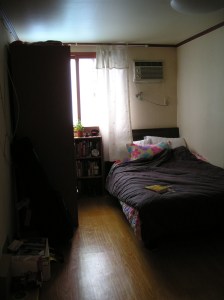
The main room/livingroom/bedroom/closet
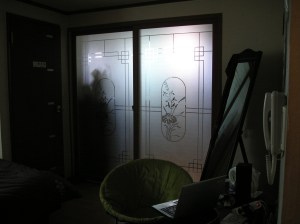
Pay no attention to the kitchen behind those doors.
The bathroom is the most interesting setup. Similar to most Asian bathrooms that I have been in, there is no separate shower stall. The whole bathroom is tile, and the shower just juts out of the wall, sprays all over the bathroom, and the water goes down a central drain. The only downside being the occasional wet toilet seat.
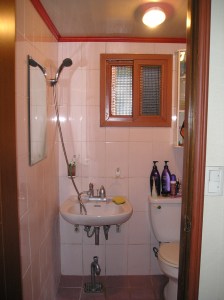
Bathroom
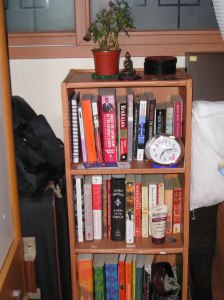
My favourite part of my room is my bookshelf. Complete with a well travelled Buddha, and a plant I’ve already almost managed to kill.
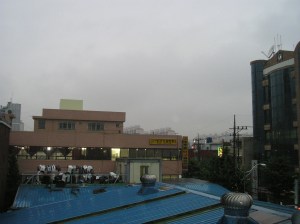
The rainy view from my window.
The brown building across the way has a ping-pong room on the top floor. Like going to play pool, except not.

