


Eco Libris, in a random act of generosity, offered 100 free books to 100 bloggers who were willing to review them. The idea is to get the word out about publishers that are environmentally friendly with their printing/paper services.
“Today 100 bloggers are reviewing 100 great books printed in an environmentally friendly way. Our goal is to encourage publishers to get greener and readers to take the environment into consideration when purchasing books. This campaign is organized by Eco-Libris, a a green company working to green up the book industry by promoting the adoption of green practices, balancing out books by planting trees, and supporting green books. A full list of participating blogs and links to their reviews is available on Eco-Libris website”.


Published by the Green Press Initiative and Heyday Books.
This is a very conversational, thoughtful, and engaging look at the history of various civil rights movements in California. Being a huge, and hugely diverse state, I think it serves as an example, and interesting reading for anyone just about anywhere. The first thing that struck me about the book, is that we really do need reminders that a short time ago in history, discrimination and violence were not only legal, but encouraged by majority groups.
Although this book could be used as a college level textbook, it is not at all dry, and has so many other uses for anyone interested in American rights movements, history, and globalization.
The book is largely split into chapters that follow a time period, but although each chapter ends a little later in time, they all go back in history to roughly the mid-1880s looking at the chain of events that lead to the breakthrough in rights. Chapters one through three look at early California history including immigrant rights and workers’ rights. The next set of chapters look at racial equality, the rights of women, and political dissent. Moving further in time the authors examine free press, religious freedom, GLBT rights, people with disabilities, and criminal justice.
The first chapter Staking our Claim was a horrific look at some the early practices of violence against, in particular, Chinese laborers and Mexican people. One story was of a Mexican woman whose house had been broken into. She defended herself, wounding her assailant, and was then dragged into the streets, beaten and hanged for doing so. This chapter references some of CA early women’s rights laws, such as a woman being able to keep her property after a divorce, which wasn’t so much for the concern of women, but to attract wealthy, single women to California as potential wives.
Under Color of Law looks thoroughly, but not only, at African American rights, times of indentured servatude after slavery was ended, and also Mexican anti-segregation movements, the Filipino movement to end anti-miscegenation laws, and the Native American take-over and protest at Alcatraz.
The only chapter not in the time line is the final chapter, and is the one that is probably most personal to the co-author Stan Yogi. It is entitled Behind Barbed Wire and addresses the removal and incarceration of Japanese-Americans during WWII. Stan’s dedication in the beginning of the book reads, “Stan Yogi dedicates this book to his parents…who were incarcerated during WWII and still had faith in the promise of American freedom and justice.”
Although this book is very readable in its entirety, there is no need to read each chapter followed by the other. They stand alone as well researched pieces that could be used as references to each particular issue.
Book Giveaway I would be happy to pass on this book. If you are interested in reading it, leave a comment and I will pick someone at random.
“We elected to print this title on 30% post consumer recycled paper, processed chlorine free. As a result, for this printing we have saved:
22 trees (40′ tall and 6″ diameter)
9,884 gallons of wastewater
7 million BTUs of Total Energy
600 pounds of Solid Waste
2,052 pounds of greenhouse gases”
Filed under: Books
How is it November 2nd already? A more robust month due to the read-a-thon, but still nowhere near my unemployed-living-in-a-camper-reading-12-books-a-month rate.
 The Cellist of Sarajevo
 The Pearl Diver
 Fourth Uncle in the Mountain: The Remarkable Legacy of a Buddhist Itinerant Doctor in Vietnam
 Cork Boat
 Che’s Chevrolet, Fidel’s Oldsmobile: On the Road in Cuba
 The Life You Can Save: Acting Now to End World Poverty
 Hearing Birds Fly: A Nomadic Year in Mongolia
 Godmother: The Secret Cinderella Story
 Krakatoa: The Day the World Exploded
My goal was to read as much as I good while also producing good quality blogs as I went. I’m not going to go back and review these books later. Minus a few edits, I think I accomplished that pretty well.
Currently reading: Hearing Birds Fly: A Nomadic Year in Mongolia
Pages read in current book: 47
Pages read total: 721
Please consider donating the charity I’m sponsoring: Child Upliftment Center
1. Which hour was most daunting for you? The last one. I didn’t do much reading, more fussing.
2. Could you list a few high-interest books that you think could keep a Reader engaged for next year? Cork Boat was fun and light.
5. How many books did you read? 3 and little more
6. What were the names of the books you read? Cork Boat by John Pollack, Che’s Chevrolet, Fidel’s Oldsmobile by Richard Schweid, The Life You Can Save by Peter Singer, and part of Hearing Birds Fly by Louisa Waugh
7. Which book did you enjoy most? I enjoyed what I’ve read of Hearing Birds Fly the most, but I was really affected by The Life You Can Save.
8. Which did you enjoy least? I loved all of the books, but with how heavy handed Che’s Chevrolet was with history, it would have been the least interesting to read last.
10. How likely are you to participate in the Read-a-thon again? What role would you be likely to take next time?Oh, I’ll definitely do it again, as a reader and blogger.
Hearing Birds Fly: A Nomadic Year in Mongolia
Although there is only an hour and half left, and there is no way I’ll come even close to finishing another book, I decided I might as well hold out to the very end. Especially since my read-a-thon was severely lacking in some women’s writing. The first two books I read were about boys and their toys, and the last one was much more rounded, but still I think I should get a little woman’s voice here. I was going to switch to fiction, but I decided to stay the course and choose a non-fiction with a worldly theme.
There are several people reading this who I think will appreciate the opening quote, “If an ass goes travelling, he’ll not come home a horse.” Thomas Fuller
Currently reading: Hearing Birds Fly: A Nomadic Year in Mongolia
Pages read in current book: 1
Pages read total: 676
Please consider donating the charity I’m sponsoring: Child Upliftment Center
Some statistics taken out of the book:
There are about 1 billion people living in what are considered affluent countries. Those countries government and private donations give an amount of money that works out to roughly $60 per person in donations.
There are 3 billion people living in poverty – living on less than $2/day. Even in countries that have very small economies, this is not considered enough money to give a person access to housing, food, education, and basic health care.
Given those two things, $60/person is clearly not enough money to be donating. Singer outlines in the beginning of the book how when people are presented with the story of a child drowning in a pond and a man wearing a new armani suit and shoes, that it is his moral obligation to rescue the child, regardless that he will ruin $3,000 worth of clothes. Although this is very over-simplified view, he expands this thought into arguments for and against helping people on a larger, and broader scale. How it is difficult for some people to offer money to people they’ve never met both in their home countries and internationally, and the arguments that can be made to cultivate a culture of giving.
Singer asks us to look at places where we spend money on things we would not miss. $3 lattes instead of making coffee at home, bottled water when we could filter, or in many places outright drink the tap water, soda at convenience stores and restaurants, clothes we don’t really wear, or more shoes we don’t need. He then asks people to look even above that for people who are capable, and consider giving even more. He argues that people should give as much as they can to just before the point that they are doing more harm to themselves than good for other people.
The book is divided into several different categories:
1.The Argument: Saving a child, why it is wrong not to help, common objections to giving
2. Human Nature: Why we don’t give more, creating a culture of giving
3. The Facts About Aid: How much does it cost to save a life, which charities do it best, and improving aid
4. A New standard for Giving: Your child and the children of others, asking too much?, A realistic approach.
His final conclusion is that if everyone who lives above the poverty line themselves contributed 5% of their income, and the super rich gave a little more than that, we would have more than enough money to combat poverty, and the three chronic health issues that he outlines: 27,000 who kids die of preventable diseases every day, at least 3 million women living with fistula who are not allowed to contribute to their local economies due to isolation, and the several million people who have gone blind from reversible cataracts.
Currently Reading: The Life You Can Save: Acting Now to End World Poverty
Pages read in current book: 174
Pages read total: 675
Please consider donating the charity I’m sponsoring: Child Upliftment Center
The Life You Can Save: Acting Now to End World Poverty
One charity I found particularly inspiring in this book is the Worldwide Fistula Fund, an organization that helps women who are injured through childbirth or violence in a way that is treatable, but often ignored.
Please, please, please watch this video. It is amazing.
Pages read in current book: 102
Total pages read: 603
Please consider donating the charity I’m sponsoring: Child Upliftment Center
University of North Carolina Press publishes some really, really interesting titles.
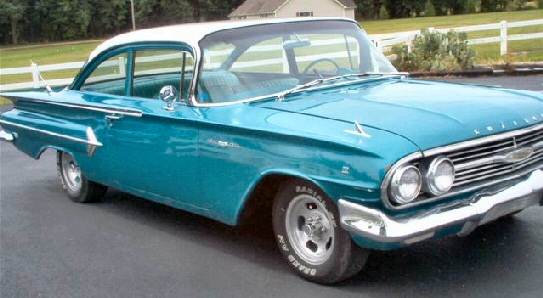 The same model as Che Guevara’s first car. His was apparently emerald green with the white top.
Che’s Chevrolet, Fidel’s Oldsmobile: On the Road in Cuba
I was not trying to start a theme, but the two books I’ve read this weekend have both involved ingenuity of transportation, and both coincidentally included stories of the author’s reaction to 9/11. In Cork Boat, Pollack is working as a Washington speech writer when it happens, so he is heavily affected by both the events and the hysterical aftermath that existed on the hill. In Che’s Chevrolet, Schweid is conducting his research in Cuba, and thinks the Israeli tourist who tells him what happened must have gotten her news wrong. He has to hunt down a ritzy foreigner hotel to see the news, as Cuba’s media is completely controlled and their are only two state run channels that show local, controlled stories.
Schweid’s book shows a Cuba that was quickly developing, with a lot of help from the US, that came to a dead stop after the revolution. With no economy to speak of, and the inability to import much, the country has stalled. Schweid makes the history of the automobile on the island the case in point, how there are approximately 60,000 1950s era cars on the road in Cuba, kept running by shear ingenuity, and piecing together parts from the Eastern European and Russian cars that are slowly imported.
He spends a chapter describing how Cuba was keeping up with America in the “planned obsolescence” of vehicle manufacturing in the ’40s and ’50s, this changed with the embargo, and I really enjoyed Schweid’s passage on how their attitude toward the cars changed:
” Mabye even now Cubans would buy a new car every couple of years, like North Americans, if they could. But the fact is right now they cannot. So they have cared for and maintained the same models that North Americans bought and threw away in great numbers, so many of them scrapped that the remaining few have become collector’s items. The mechanics in Havana and Santiago de Cuba who have kept these cars running all these years belong to a genre of Cuban genius. They have done these cars much prouder than the manufacturers who built them to throw them away.”
Pages read in current book: 216
Total pages read: 501
Please consider donating the charity I’m sponsoring: Child Upliftment Center
Mid-Event Survey:
1. What are you reading right now?
2. How many books have you read so far? 1.5
3. What book are you most looking forward to for the second half of the Read-a-thon? Haven’t quite decided, but Mongolia, a card-toting messenger, and a food writer are some of the options.
4. Did you have to make any special arrangements to free up your whole day? No, but I am skipping out on bookclub today.
5. Have you had many interruptions? How did you deal with those? Well, the dire need for sleep, which I combated by sleeping.
6. What surprises you most about the Read-a-thon, so far? Maybe I haven’t been checking in on the right blogs, but I thought there would be more writing about the actual books. I’m fine either way, that was just an expectation that I had. I’m surprised at myself at how little reading I’ve gotten done. I had pretty lofty sights on my pile of books.
7. Do you have any suggestions for how to improve the Read-a-thon next year? I think it’s going really well, I’m definitely enjoying myself, and enjoying cruising around other people’s blogs. It would be interesting to see blogs split up by genre category – people who read mostly PUF, mystery, literary fiction, non-fiction, YA, and anything or everything category.
8. What would you do differently, as a Reader or a Cheerleader, if you were to do this again next year? Organize my snack options better. There’s nothing in this house I want to eat, but I don’t want to go out and get anything either. I may have to try to convince a friend to go on a pizza run.
9. Are you getting tired yet? Not after my very refreshing nap. 🙂
10. Do you have any tips for other Readers or Cheerleaders, something you think is working well for you that others may not have discovered? I know how I like to format my book blogs, so I did some work earlier this week hunting down pictures and links and saving them in “draft” blogs so that if I got tired and spacey, I wouldn’t have to spend time doing that during the read-a-thon.
Pages read in current book: 76
Total pages read: 361
Please consider donating the charity I’m sponsoring: Child Upliftment Center
It was great to wake up from my longer-than-a-nap, shorter-than-a-night of sleep, to find all the comments. Thanks for the cheerleading!
One of the great things about my current book: Che’s Chevrlet, Fidel’s Oldsmobile, is that our narrator is not your typical travelogue writer. He’s an American in his sixties, born and raised in Nashville, schlepping around a back-pack and standing in hours long bus lines. In one scene he attempts to copy a college student’s trick of jumping off the back a camello (an open wagon type thing, hauled by a tractor that is very popular public transport) at his destination instead of waiting for it to stop several blocks later. While the college student nimbly hits the ground running and makes an easy exit, our narrator ends ups up on his back in the middle of street glad that there wasn’t another vehicle behind the camello.
I really liked Shweid’s description of the cars of Cuba, “These cars are like old people. They have liver spots of discolored paint, an inability to retain their fluids, and a coughing ignition that makes it hard for them to get started in the morning.”
From the book:

Currently reading:Che’s Chevrolet, Fidel’s Oldsmobile: On the Road in Cuba
Current book pages read: 56
Pages read total: 341
At the last moment I changed my mind about what my next book would be. I heard mention of this book in an Orion article, and have been really excited about it ever since. So far it is off to a promising start. Since the embargo started between Cuba and the US, no car parts have been allowed to be shipped in. Although Cuba can import cars from Russia, they are often too expensive for the current Cuban economy, so people through shear willpower and ingenuity have been keeping 1950s cars on the road for decades.
I’m probably going to take a nap while I read this…
Che’s Chevrolet, Fidel’s Oldsmobile: On the Road in Cuba
Current book pages read: 19
Pages read total: 304
Please consider donating to the charity I’m sponsoring: Child Upliftment Center

