


Filed under: Buddhism, Korea, Travel | Tags: Geumsansa Temple, Temple stay Korea
After nine months, I finally did one of the first things I intended to do in Korea – go on a temple stay. I wasn’t the only one in this boat, several of the folks I talked to on the trip (of 33 people, I think), were doing the same thing. Some were on their way out within the next couple of weeks, and were finally getting around to doing the stay. It is less of a meditation retreat, and more of an introduction to Buddhist temple life turned craft camp. Overall it left me feeling better about being in Korea, was relaxing, and was a great chance to hang out with like-minded foreigners and some cool Korean folks.
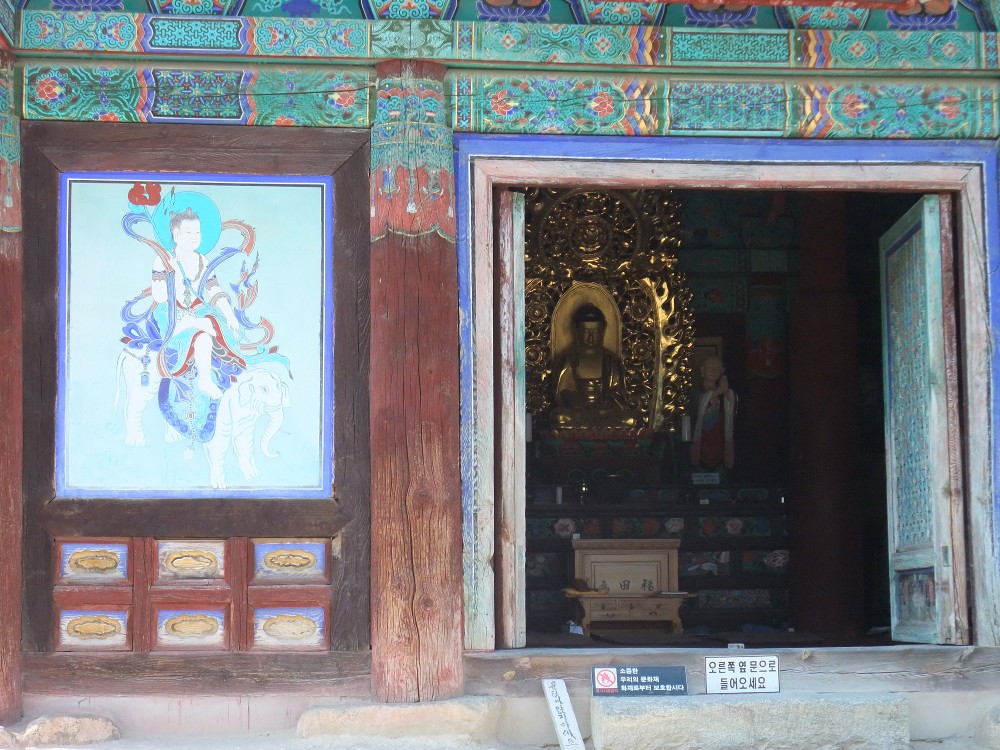
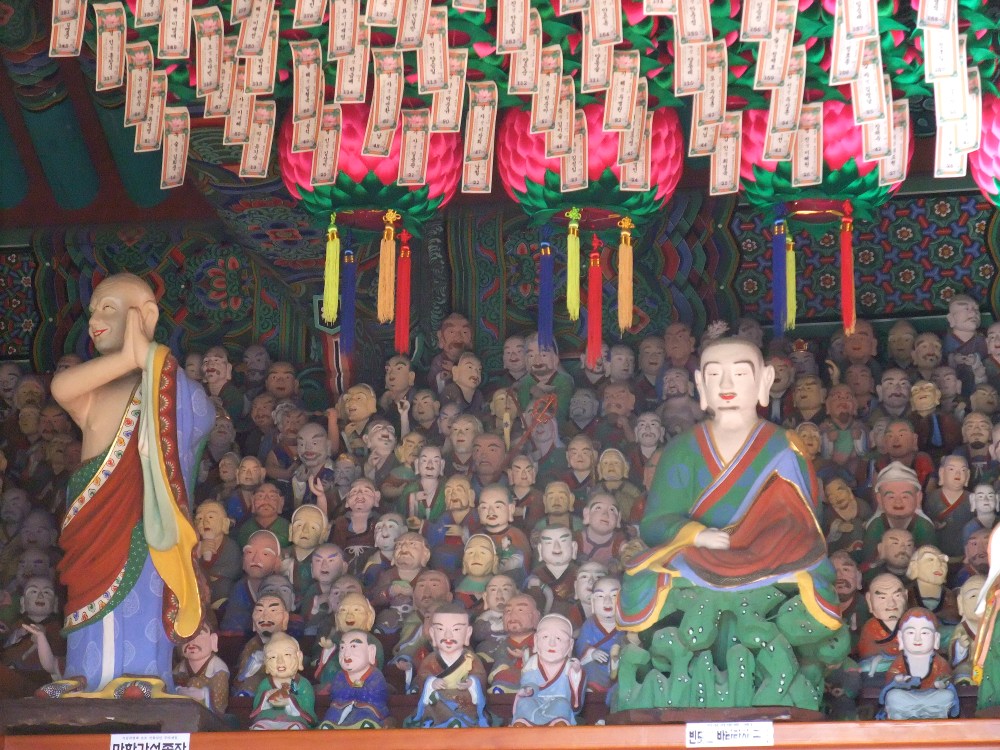
For me, the highlight of going to temples is the art. Besides finding it inspiring, it is a relaxing dose of color compared to the concrete jungle with neon signs that is the rest of Korea.
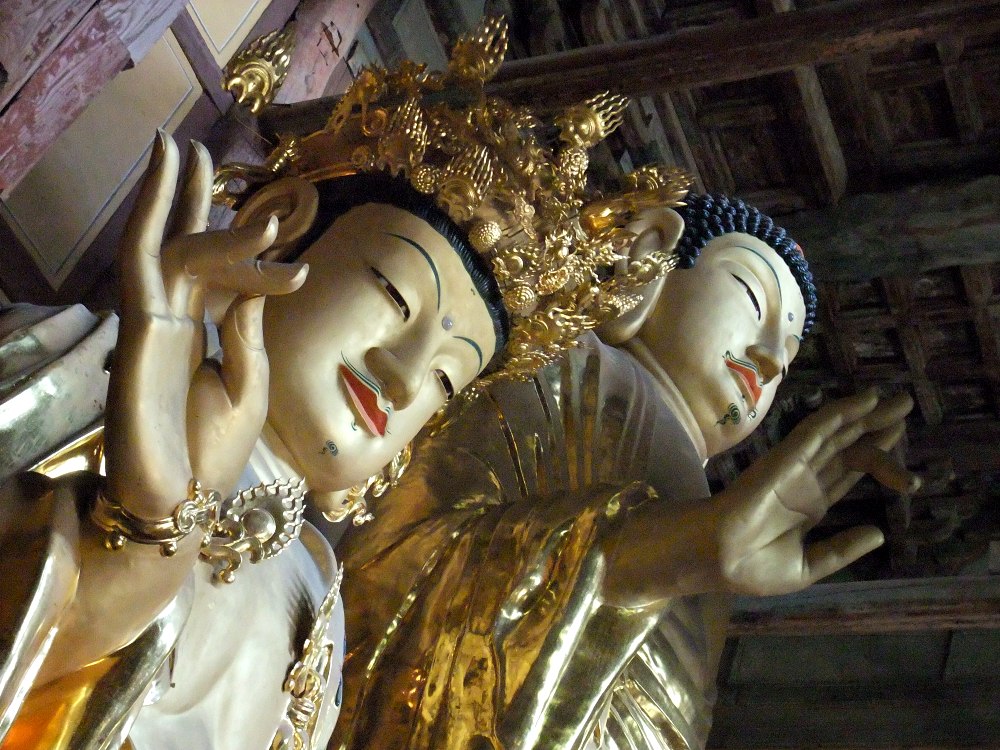
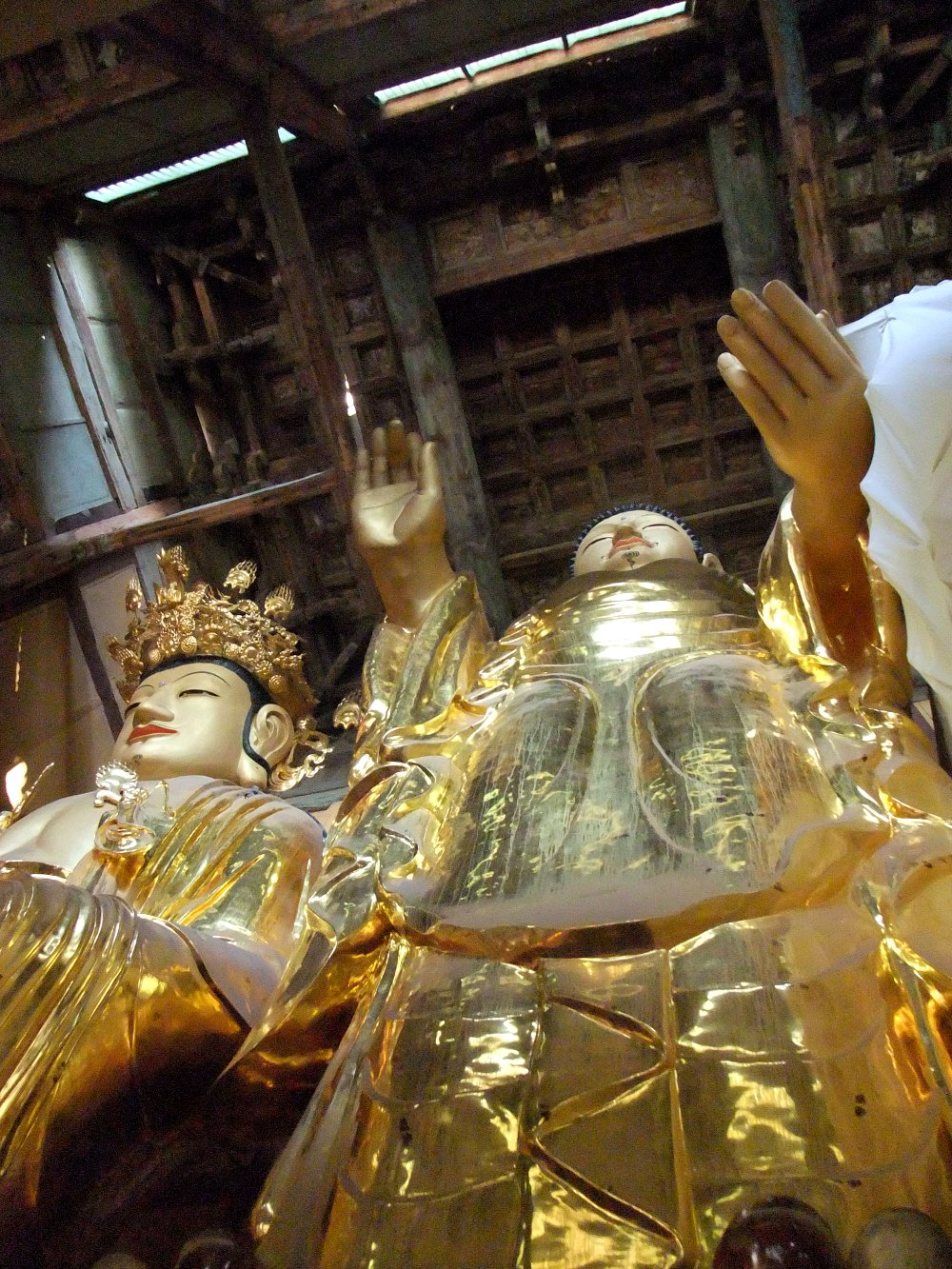
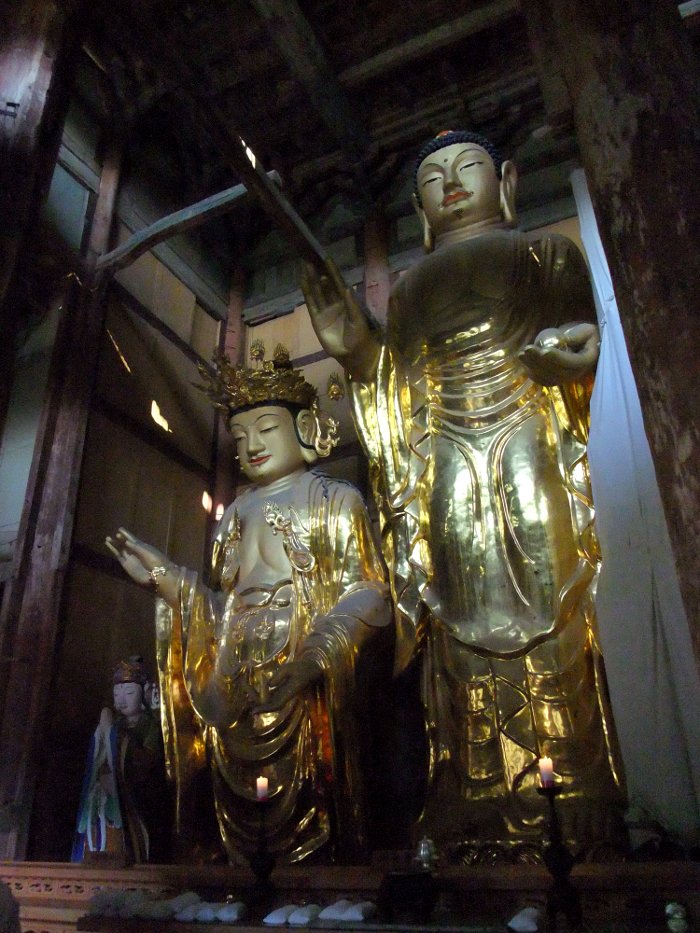
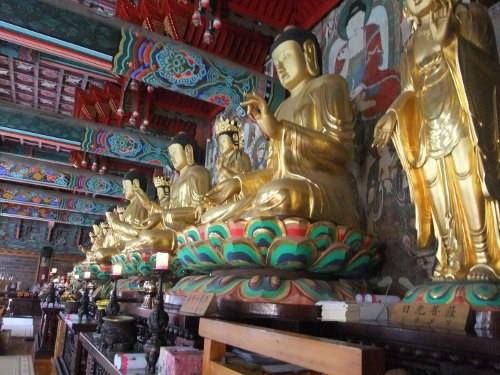
Gemsansa is made up of many buildings holding a different main Bodhisattva, but this one is particularly spectacular. It is three stories high, and on the inside holds a statue that takes up every bit of that three stories. We were allowed to take pictures, which is very rare inside temples.
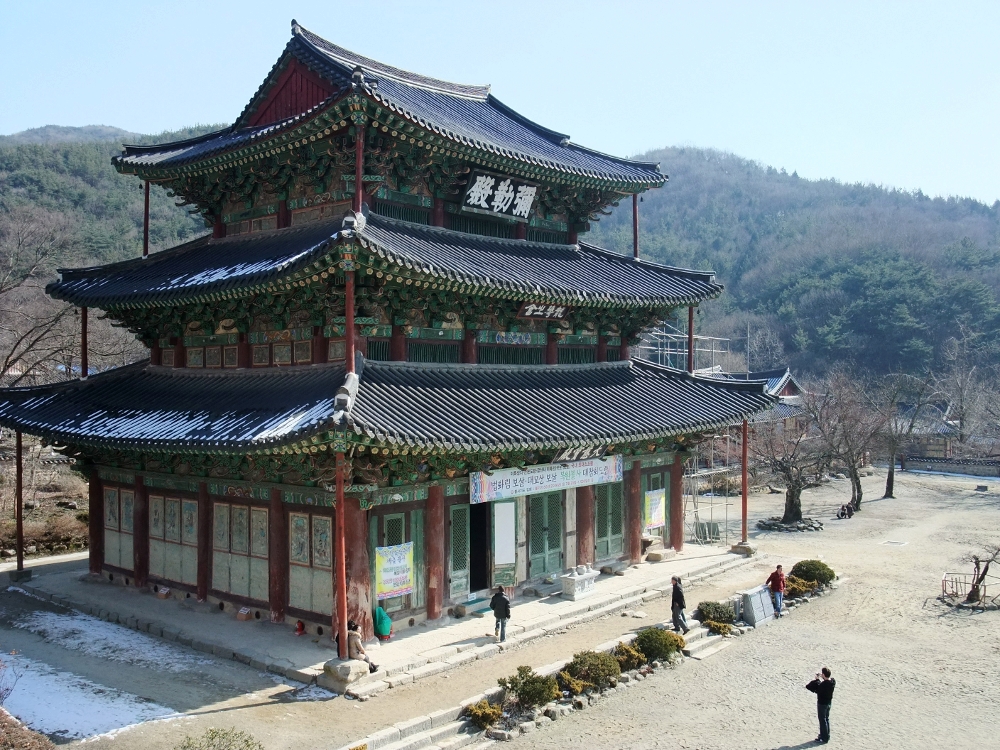
Temple Housing Maitreya Buddha.
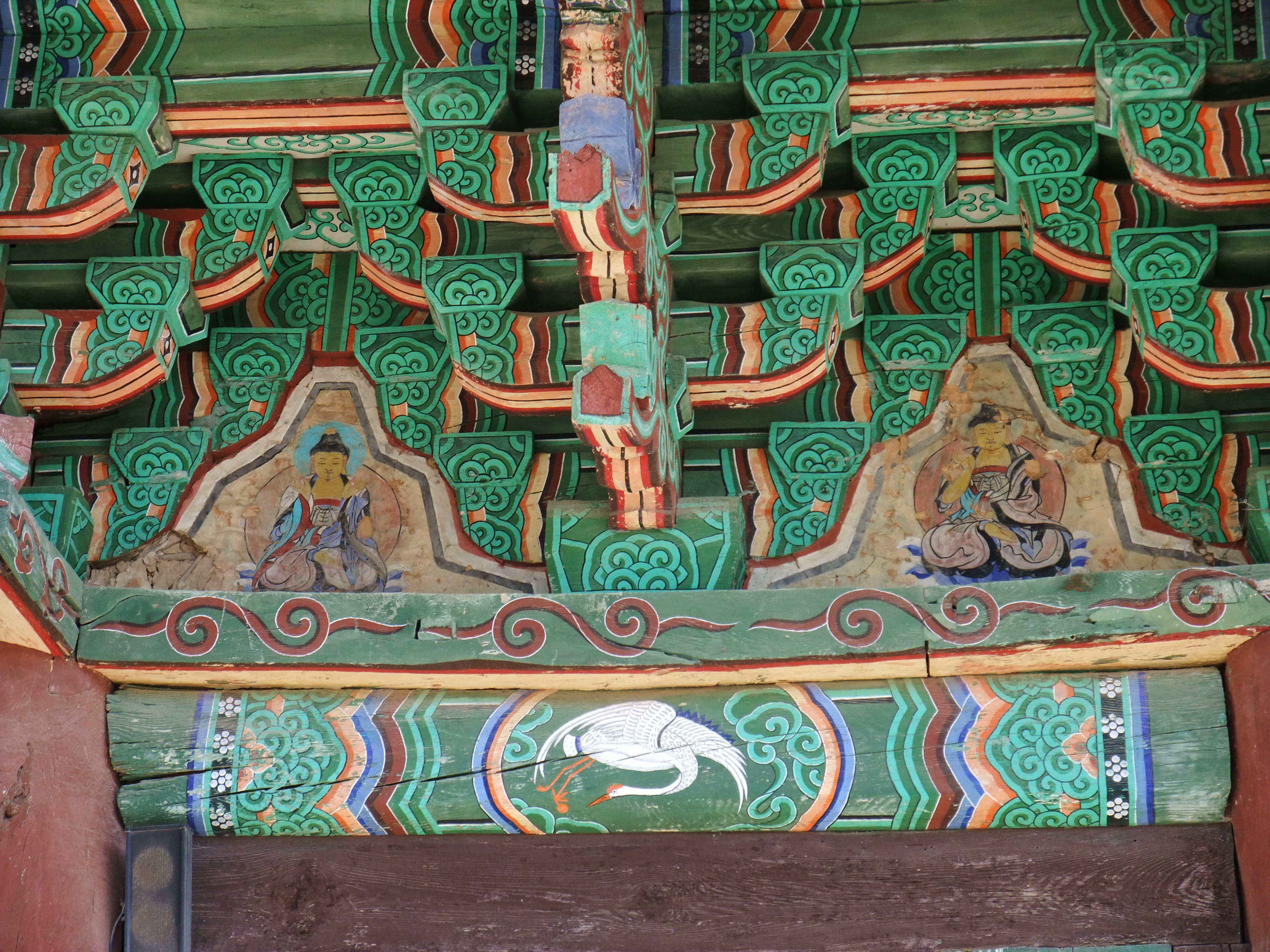
Close up of the artwork on the building.
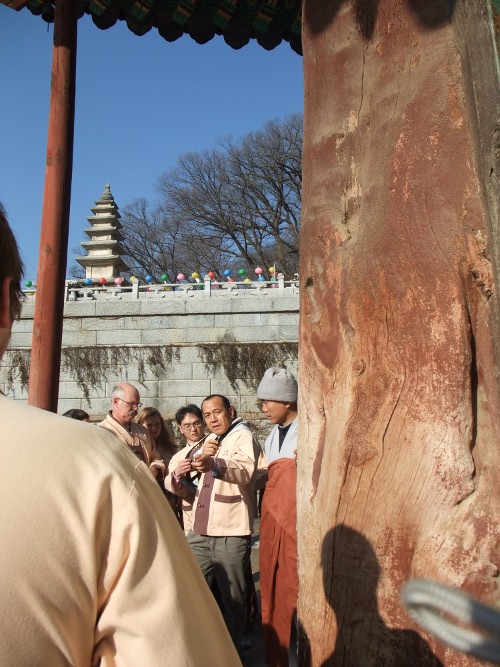
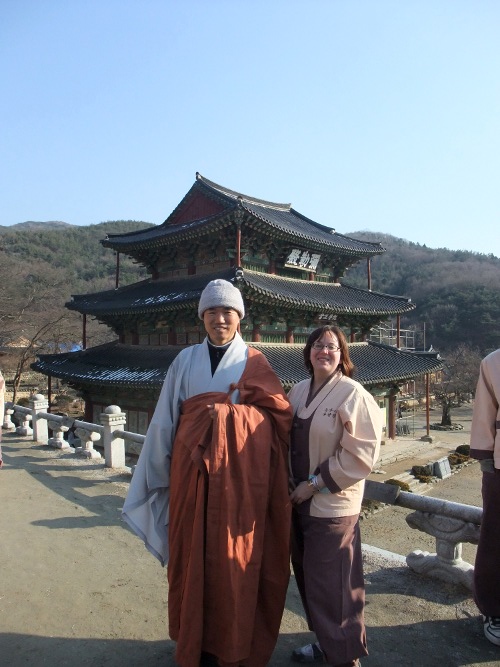
Our monk host and translator describing how it is unique to Korean temples to use the natural shape of the tree as pillars to the the buildings. He was a wonderful host, extremely open, friendly, and excited to share. He said the first time he was given the temple stay for foreigners as an assignment, but ever since 2004 he’s volunteered to be the person to be in charge of leading them.
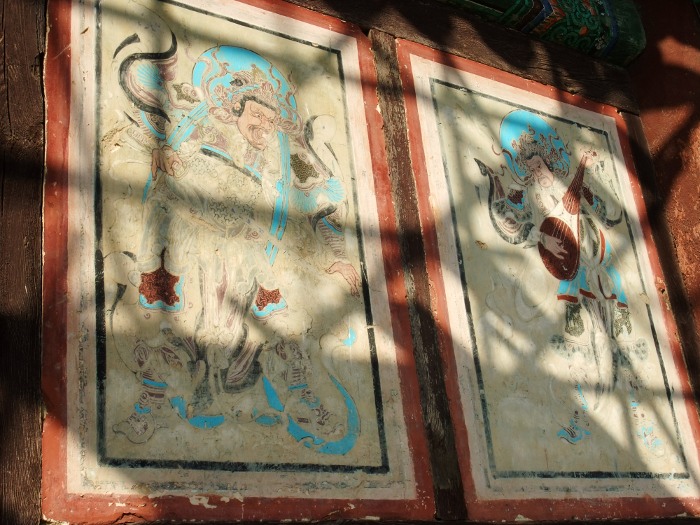
The warriors: mean, scary-looking, but ultimately fighting for compassion against the evils of greed, hatred, and ignorance.
Inside. I think it’s hard to tell from the pictures, but keep in mind that these statues are three stories tall.
At the base rubbing the wishing rock and looking up.
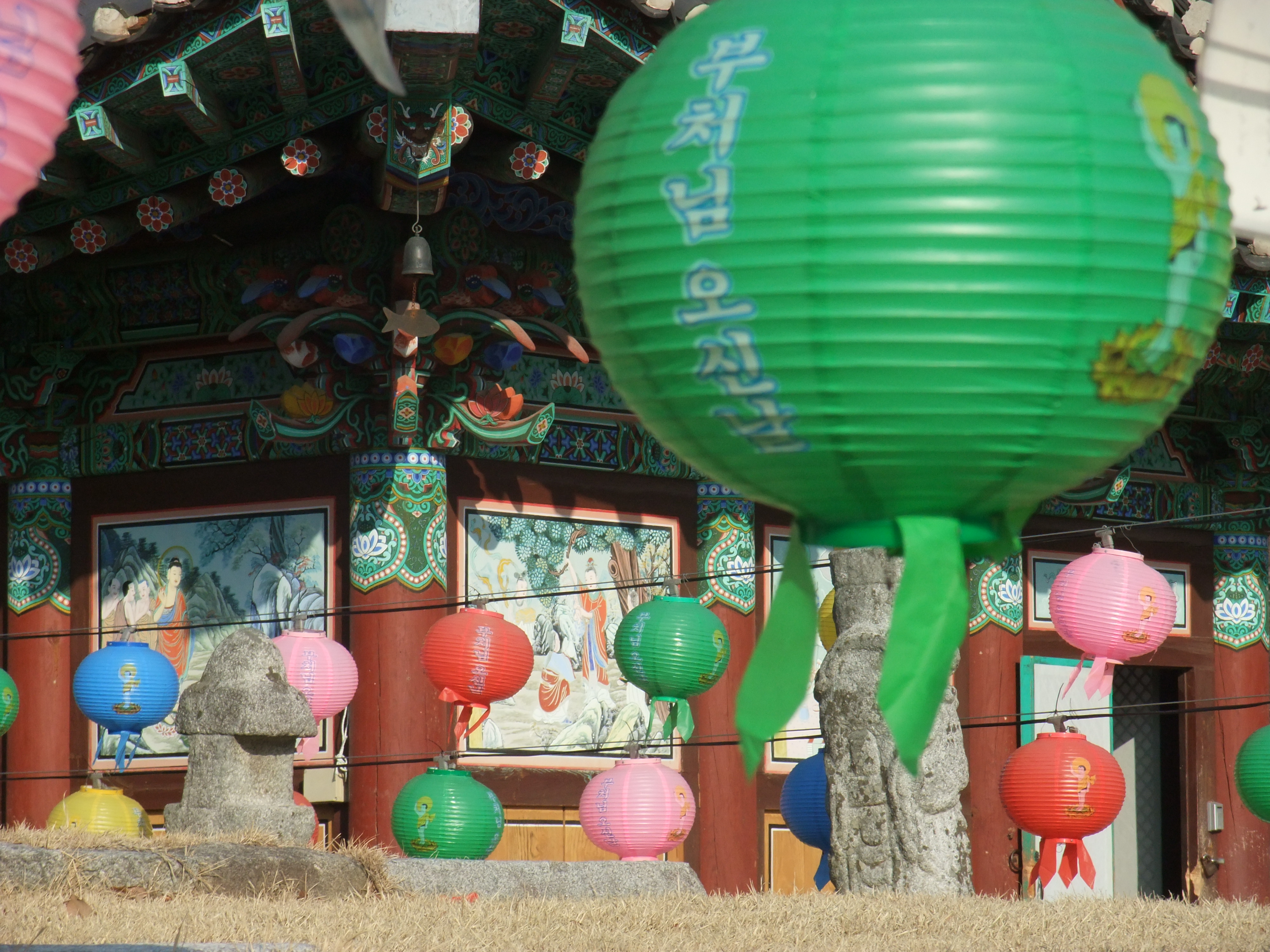
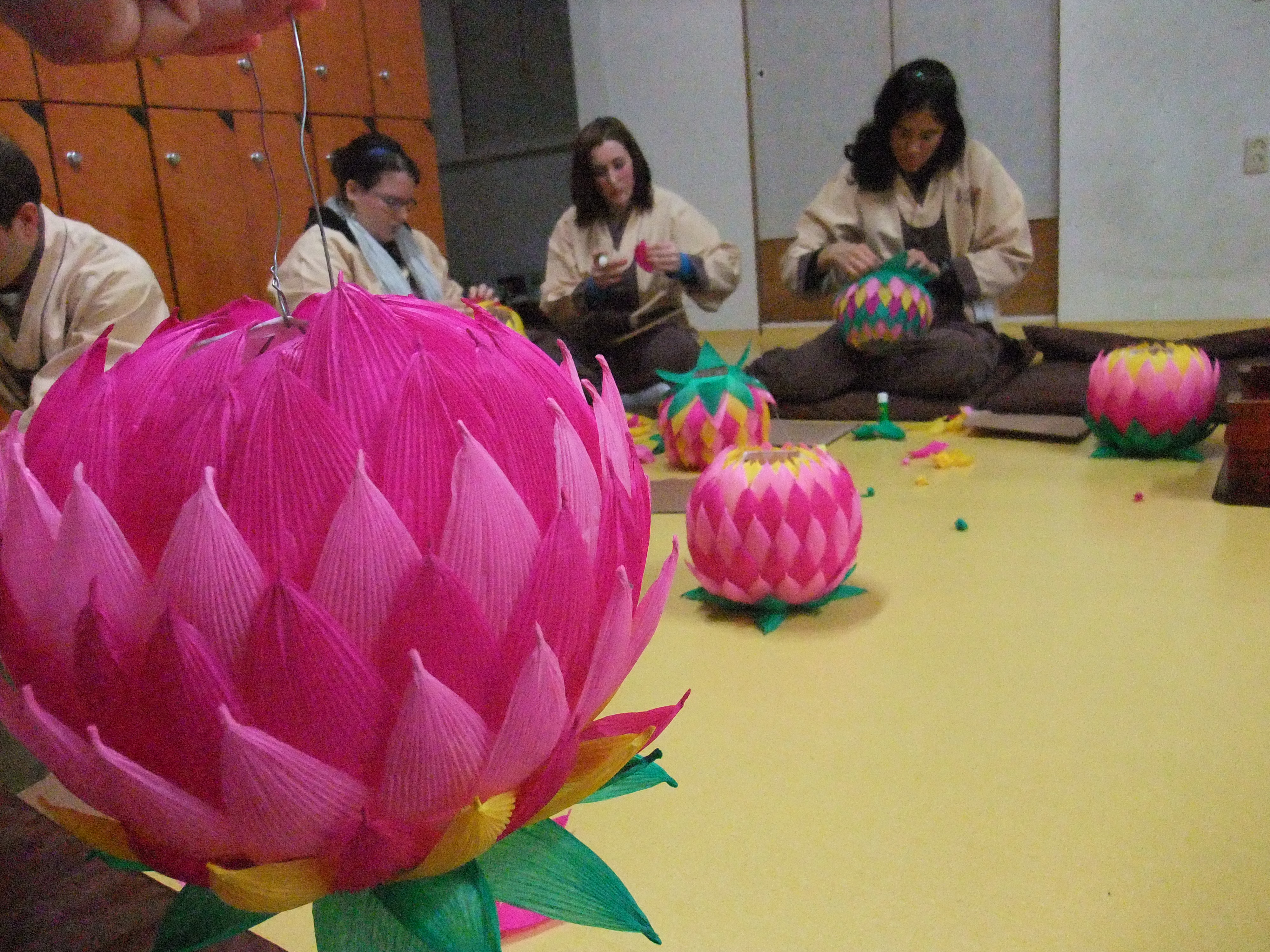
After a meditation session, and lengthy Q&A with the monk we settled in for the arts and crafts part of our sleep-over. Some grandmas came in to show us how to make tissue paper lotus lanterns. It was great to see that out of all the people, no two were exactly the same. People came up with some pretty clever designs.
At first the grandmas seemed a little unsettled by our creative license, but they warmed up to it after a while.
I asked the same question that I asked a monk in Yeosu a while back to our monk here and got a completely different answer. “What do you think about the turn in your own culture away from Buddhist principles to completely embracing capitolism to the point of extreme materialism, and a huge focus of physical appearnce and material success?”
Since I’ve come to Korea, I’ve had this question in my mind. Although the people here have every right to develop their culture and society however they want, it has been a personal disappointment to me that a country that used to be Buddhist has become so extremely consumerist. This question had been burning in my mind even more the last couple weeks after a great project I did with some of the students at school. They were asked to create a new superhero, and had to list the three top qualities a hero should have. Almost all the groups put being handsome/beautiful as the top quality because, “No one can trust someone who isn’t beautiful.” This was hugely disheartening to me, especially in light of the western concept of heroes where they are often the underdog and end up having an inner quality that puts them above the rest.
The monk in Yeosu basically said that people are going to do what they are going to do, and that monks live in a realm above that. It almost seemed like he didn’t care. It was an unusual temple were it appeared, to me, that the monk had completely surrounded himself with quite expensive looking material comforts, and although he was kind and informative, he seemed to be the ruler of his domain.
The response I got at Geumsansa was much different. This monk went into a lengthy description of Korean history, and how the materialism we see today is born of a desire to fight their way out of extreme poverty and the devastation left by Japanese occupation and the war. He kind of described it as the natural projection of that success, but that he sincerely hopes that Korea is going to enter a new cultural age. He ended by saying that Korea is going to need a lot of encouragement from foreigners who are interested in actual culture. There are some of us interested in more than just the new cell phone technology.
The next morning we were up at 3am to observe the monks’ daily morning prayers in the main temple hall. It is a gorgeous temple with statues representing several of the main Buddhas – medicine, shakyamuni. I wish I had written down the list when they were doing the tour because I can’t remember them all, and some are specific to Korean Buddhism. One thing I’ve noticed in almost all the Korean temples I’ve visited is a lack of the Taras – the 24 female Buddhas.
Later in the day, our second craft project entailed making our own set of prayer beads. I have several sets from various travels, and the set I use the most was a gift from a guitar player friend in Nashville, but these ones are particularly special, in that I really had to work to earn them. Instead of just stringing the beads, we had to pick a temple to go into (I have to admit to being selfish here – I picked the main hall because it had heaters and it was freezing outside), and then between stringing each bead we had to do a full prostration. The classic 108. I made it, and feel all the better, if sore, for it.
I would highly recommend this temple stay. I’ve heard some of the other’s described as “being a straight jacket for the weekend” or “we were like slave labor for the temple for the weekend.” This temple stay was beautiful, informative, and busy – but with enough time to collect yourself. Everyone on the trip was a good sport as well, which made for a much smoother weekend. I went with Adventure Korea, which is doing the same tour again the end of March.
Filed under: Books, Buddhism | Tags: Adeline Yeh Mah, Amanda Ward, Amy Bloom, Coetzee, Ian Baker, Joey Comeau, Miriam Toews, Peter Matthiessen
I’ve come full circle, for a year of blogging, reading, and moving half-way around the world. This month may have been a little too eventful, but it was a robust reading month.
 Disgrace by J.M. Coetzee
I was surprised to see this on NPR’s 100 best beach books list. To me a beach book is something you could recommend to anyone – non-offensive, delightful, and easy to read. This is none of those. The only reason I can think of that it would be on a beach books list is because it is relatively short. Although I thought this was an extremely well written book, and I will seek out more Coetzee just for his prose, this is one of those books that I would only recommend to people who I know to have some fortitude in digesting harsh subject matter, and who are “true” readers.


Now this could be a beach read. Even though it does have some interesting moments, I think you could read it with your toes in the sand without it ruining your day. It was decent, but not great, a Russian immigrant to the US in NYC decides to travel across the country by foot when she hears that her daughter may still be alive and living in Russia.
 by Amanda Eyre Ward
Kindle Version

Another book about a family member searching for someone who is lost. A girl goes missing, and years later her sister thinks she finds her in Montana. Another light but decent read.
 by Ian Baker
Kindle Version

A travel narrative of Baker’s slog through the heart of Tibet to the rarely seen Tsangpo river, which is believed to be a sacred place where people can achieve enlightenment on earth. I enjoyed the book, although due to the nature of his journey, it is quite repetitive. His knowledge of Tibetan folk lore and history is extensive and added interest, for me, to the book. Overall, I think he does fall into the trap of writers such as Micheal Palin where he is a western man out to “acquire” the piece of the world his heart and mind desires.
This video is unrelated to the book, but it gives you a good idea of the area:
 by Miriam Toews
I picked up this book in Beijing at the Emperor Guest House for my friend Bybee who is collecting Canadian authors. I enjoyed this story of a sweet neurotic mayor of the “smallest town in Canada” as he tries to convince the Prime Minister (who he believes is his illegitimate father) to come for a visit. The book is full of great, quirky characters – like the four year old named Summer Feeling, and reminded me a little bit of the writing of Fanny Flagg.
 by Pietra Rivoli
Kindle Version

What a book of this type should be – informative, yet conversational and engaging. Rivoli travels around the world from cotton farms in Texas, to T-Shirt factories in China, to second hand clothes shops of discarded American clothes in Africa.
 by Adeline Yeh Mah
Kindle Version

When Adeline’s mother dies after having her, her father marries a Chinese-French woman who abuses her stepchildren and turns the family away from the unwanted girls. What was most surprising about this book is what an amazing sense of humor Yeh Mah has. Even though this was a tragic story, she found many places to add absurdity and humor.
Lockpick Pornography by Joey Comeau
This is a free PDF version of this short fiction by a Canadian author depicting a young man’s anger at feeling dejected by the heterosexual majority. He gets back at the mainstream by stealing from middle class houses that appear to have “typical” families in them. A group of young friends devises a way to make a big public statement challenging the gender paradigm.
 by Peter Matthiessen
I like Matthiessen, but I often find him to be quite male-centric and arrogant. In this book he lays aside his usual macho-ness to describe the death of his wife and his transition (because of her interest) into Zen Buddhism. I’m not surprised that he is attracted to this particular branch of Buddhism since I’ve found it to be also very male-centered, hierarchical, and controlling. Unfortunately after the initial personal aspects of the book are finished, I think it was rather dry and uninteresting.
My three day weekends are dwindling. I’m fairly certain that the wonderful four day work week was just my prize for being one of the “newbies,” and that in two weeks I’ll be back to a five or six day work week. It has been great to have to have long weekends to explore Korea, and this weekend we took the bike out again and headed to the nearby Ganghwa Island. Ganghwa, and several of its neighboring islands are all part of the Metropolitan City of Incheon, even though like Buypeong, they have their own city offices as well. I’m not clear on how municipalities work here.
Ganghwa and Seokmo Islands make great day trips. There is a lot of cultural stuff to be seen, and true to seaside towns everywhere, there is a certain relaxed air along with the cool breeze.
The north side of Ganghwa island is spotted with dolmens, archaeological features made out of gigantic rocks stacked in various shapes. The most common in this area are table dolmens, two to four large rocks form a foundation, and a huge cap stone is placed on top. These rocks cover underground burials.
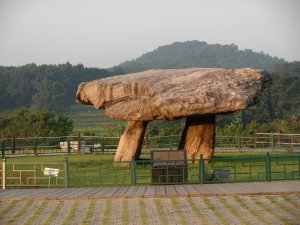
Table Dolmen
We took a road around the island, and headed south. The island is dotted with military checkpoints, and at one point we took a wrong turn, the soldiers quickly turned us around, looked at our map like they’d never seen one before, and pointed us in a vaguely different direction.
We ended up at Oepo, which we didn’t realize until the next day. Everytime we showed someone our map, first they acted really confused as to how or why we didn’t know where we were, and then they would flip through the atlas looking for something familiar, but it became pretty clear that map reading is not something many folks are exposed to here. I suppose that’s true just about everywhere, especially in places where people tend to lead fairly localized lives.
Oepo is a sea town famous for it’s raw fish restaurants. Neither Jim or I are really big on that, but I talked Jim into being more adventurous about food and we picked one. After much gesturing and getting nowhere, the waiter finally just dragged us over to the fish tank and motioned for us to pick one. There were conchs, which we tried one, flat brown spotted fish, and then regular looking long chubby fish. We tried on of those, having no idea if it was going to be cooked, prepared, or just served whole on a platter. Here’s what came out first:
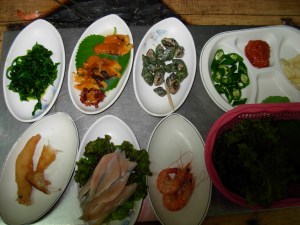
Side dishes at the raw fish market
A seaweed salad, the conch – which was really weird, slimy, salty and slightly bitter, some sort of snail that tasted like clams and we had to fish them out of the shell with toothpicks, the ever-present side of peppers, garlic, and chili sauce, fried shrimp (complete with shells and heads), a fillet of small relatively tasteless fish, some cooked whole shrimp, and basket of greens.
The fish we ordered came out raw on a pile of clear “noodles” cut into delicate little pieces with side of slightly different chili sauce.
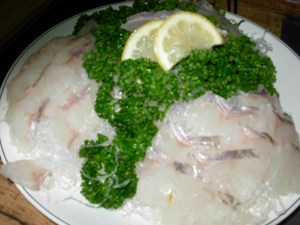 It was really good, and then a soup with the head and the tail of the fish in it was brought out. The soup was fantastic, but really, really spicy. We managed to avoid the head of the fish, I never knew that fish eyeballs turn completely white when boiled, until the waitress came out and cut up the head with a pair of scissors, releasing the bones, scales and who knows what else into the broth. It was kind of sad.
Unfortunately, I felt like most everything except our large fish tasted vagely of dirty ocean water, but we got out of the culinary adventure relatively unscathed.
The next morning we hopped a ferry to Seokmo Island, where the very famous Bomunsa temple is nestled on a cliff-side of one of the interior mountains. It was a lovely area, with a huge, gorgeous temple. It was the hottest I’ve felt yet this summer, but the place was still teeming with people.
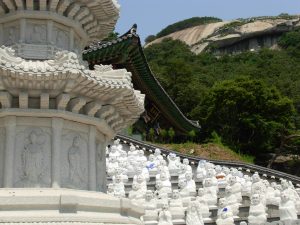 It is a holy site that has several components that have all been combined into one temple. There is a cave temple that was built around the year 635. I didn’t get a good shot of it, but in this shot from above the cave looking down on the buildings you can see the top of the rock that is the temple. Cave temples are one of the things I am really interested in regarding Mongolian archaeology. Buddhism has been persecuted many times as a religion, particularly in North Eastern Asia. In Korea many of the monks took refuge in the mountains and in Mongolia they went into hiding in caves. This part of Korea used to be the capitol of the country, and was invaded by Mongols in the mid 1200s.


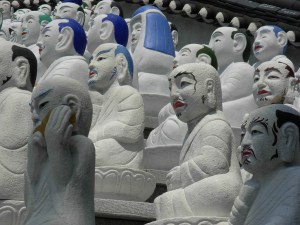
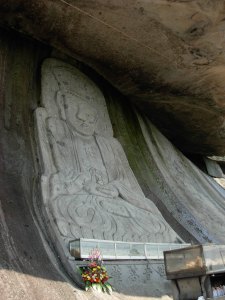
Also at this site is a 32 foot carving on a cliff face of Buddha constructed in 1928. It was a difficult and really hot climb up the side of the mountain, but we got to talk with some students whose parents were eager to have the money they spent on English lessons put to use. We talked for a while with a college student who gave us some information on the area and was really friendly, until it became clear his father was upset his son was spending time talking to us instead of praying.
Hot and exhausted we caught the ferry back to Ganghwa and did a tour around the south end of the island, which was a huge mistake. There was an enormous sea of people going to the beach that day, and between people trying to park along the road and all the folks walking, it was impossible to get anywhere. The beach wasn’t a sandy beach like we think of it, it was low tide, and a giant mud flat where people were digging for shellfish, rolling around in the healthy benefits of sea mud, and generally getting sun baked. Who needs mudfest? Folks can come to the beaches and get covered in mud anytime.
We finally made it through and made a pit stop at one more temple before riding home. I was so tired at this point, even I couldn’t find much to be excited about. Jeondeungsa temple seemed very new to me, and in fact several new temple buildings were under construction. People were buying slate roof tiles and writing things on them that I assume where going to be blessed and then used on the roofs of the new buildings.
I did like this temple that had “guards” in the doors. I wasn’t sure if they were there to keep evil spirits out, or to bonk lazy practitioners such as myself on the head as people walk in.
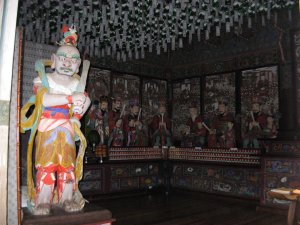
We finally headed back to the Incheon mainland, feeling culturally fulfilled. We got quite lost, and a really generous Korean man in a car saw us scratching our heads and looking at street signs. He was trying to give us directions, but then just decided to go out of his way and drive us to the intersection we needed. It was such a great ending to the day to have someone go so much out of their way.
As we were following him, we noticed he was driving a Ford.
Jim’s grandfather was stationed in South Korea in the late 1940s, right before the outbreak of the Korean War. He was stationed in Yeosu, a then almost nonexistent, and now still small coastal town on the south end of Korea. I learned from a friend that Jeju Island was a stronghold of communist support, sandwiching the mainland between themselves and what is now North Korea. This may be a possible reason for why so many folks were stationed along the southern coast.
We had a long weekend away from the hagwon, and decided to take a trip south. Not just any trip, no, no, we ventured on Jim’s motorcycle all the way from Incheon. Well Jim, did anyway. He left on Friday morning, and as I had to teach Friday, I caught a bus to Gwangju.
Gwangju
Since I don’t work for a public school, and have almost no vacation time for this entire year, the unexpected opportunity to take a long weekend was too much to pass up. Being the kind of adventurer I am though, I always try to fit in too much. My original plan to meet a couple of friends in Dangjin for drinks was foiled by the fact that a huge percentage of the country also had this weekend off, which left me with no train or bus tickets to anywhere I needed to go. I was at the bus station, wondering what the hell to do, when I finally got in touch with Jim, who had been riding his motorcycle all day. He was close to Gwangju, and wonders abound, it was the only bus with any spots left that night at the terminal. I bought a ticket, checked with the guidebook since I really had no idea where Gwangju was, and settled in for a four hour bus ride that started at 11pm.
Since there was no way Jim and I were going to find each other, when I got to Gwanju, I just found a motel and passed out. When Jim called the next morning, it turned out he wasn’t that close to Gwanju, and I needed to entertain myself for a few hours. See, this is where I get myself in trouble. Open the guide book, see what there is in the area – ah, Mudeungsan Mountain, that sounds like fun. I hopped a bus in the right direction, keep an eye out for the Wonhyosa temple entrance, and I’m off.
The bus took a long route up a winding mountain, and it turned out I didn’t need to watch too closely as the Wonhyosa temple was the last stop on the bus line.


Jim called, and was still a while away, so I decided to take a walk up the mountain trail. This is where I really got in trouble. Not wearing good shoes, with a shoulder bag full of books and clothes, but the never ending desire to get a few good pics and a decent hike in, I struck out on a path that said it was headed to another temple, where supposedly I could catch another bus. All would have been well and good, except that I fell twice on my already fragile knees, making for slow hiking, and when I got 9/10ths of the way to the temple – straight downhill almost 3 miles, the trail was washed out and a giant fence was put up to prevent people from trying to scramble around. I looked up the mountain, it was physically impossible for me to get back up that mountain at this point. My knees were a mess, I had no water, and the really crappy Chinese I had for breakfast was long burned up. There was a little path to the right that was my only bet, but I didn’t have the slightest idea where it went.
Jim calls again, “I’m in Gwangju.” Well, that’s great, but I’m lost in the woods.
After much walking, slipping once again and getting chastised by an old Korean man for my poor choice in hiking foot attire, I found my way to an entrance to the park and another bus stop. As is pretty common, none of the bus stop signs were in English, so I just had to get on a bus and hope it was headed toward Gwangju. Luckily it was, and although I couldn’t figure out how to get back to the station, I was able to get into town and then take a taxi to the bus station.
On the bike, 22 to 17 south.
Yeosu
Yeosu is nothing like what it was fifty years ago. Although it is still a fishing town surrounded by rice fields and farms, it has fallen into the concrete pattern of the rest of the country. One thing that strikes me here are some of the places that food is grown. You will see corn plants right up the road, with no break or ditch like there would be at home. Squash and melon plants are spilling onto the streets and hanging off roofs where they are grown on sheets of plastic lined with dirt.


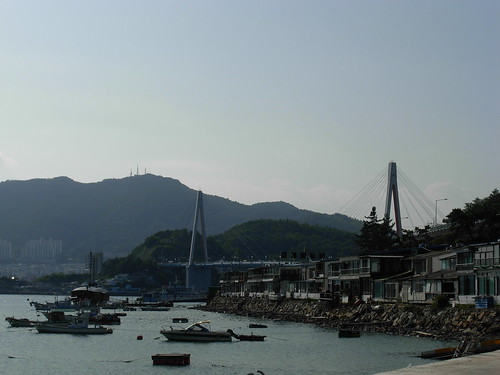
There are several islands off of Yeosu, and a road that connects them all. Well, almost. When we passed over the first bridge, I was thinking it looked suspiciously new. Sure enough, half way through the first island, and the road ends in a corn field. Development is so fast here that roads that are still “to be built” are labeled as real roads on the map, because it would be pointless to update maps every time a chunk of asphalt is put in. The geography of Korea changes constantly. A country that was once completely leveled and deforested is now 90% re-forested and covered in amazingly lush mountains top to bottom.
We turned back around and decided to try and take the road around the islands from the other direction and see if we could get any further. We pulled off onto a road that said it had a temple on it. A long, winding, partially paved, hole-filled road. At the end, it just looked like a row of dilapidated buildings. Just as we were about to pull away, a very excited woman calls out in English, “Oh please come up!!” She saw Jim’s Ohio State t-shirt and was immediately ecstatic over seeing a couple of fellow Americans. She is a Korean woman who emigrated to New York over thirty years ago, and had come back to Korea to reconnect with family and her roots.
As we came up the stairs, we could see what we couldn’t see from the road. This was indeed a giant temple, complete with retreat cabins, giant statues, and a huge temple shrine. Twenty years ago a lone monk decided he wanted to start a temple in this gorgeous location, and set out raising money on his own.
What struck me was how much the area looked like the Maine coast. Pine trees and mountains that come right up to the ocean. Some of the pics here could be confused for pics I took living in Bar Harbor.


Chong, our new Korean-American friend, went out of her way to ask the resident monk if he would mind meeting us. He invited us in for tea. This is why I came to Korea, to meet monks and hang out in temples. He was wonderfully gracious and talked to us for a couple of hours. He even gave us a meditation lesson, and gave me homework. Chong said he gave me homework because he wants to see me again. I asked if I could come back to do a retreat and he told me if I practice, I can come anytime, but if I don’t practice meditation, he will know. It was great, and one of the most beautiful places I have seen. Chong said she wasn’t even planning to come to this temple when she first came, she did like we did and just visited on a whim – and then never left. She’s been studying there for a year and plans to stay for two more.
The monk also said that if any foreigners are interested in coming as a group for a retreat, he would be really interested in teaching it, so if you are interested, we can coordinate, and I will contact them about having a group receive a teaching.

The hardest part of the trip was getting back. We made it the entire length of the country in a few hours, and then spent the same amount of time just getting from Seoul to Bucheon. It made me wish we lived somewhere like Gongju where we would be close enough to Seoul to bus in, but far enough away to enjoy the country.

The bike getting a rest from our butts, or our butts getting a rest from the bike. I’m not sure which.
The monsoon rains have made my grand weekend plans difficult to maneuver lately. Unfortunately I no longer have three day weekends since I’ve taken on teaching a summer intensive. I now teach three, three-hour classes a day. I missed a “company party” – read the boss gets really drunk and tries to control and humiliate his employees – something I am trying very hard to avoid ever having to go to, but I’m sure there will be ramifications for my not making it.
My original plan had been to go to Gongju for the long weekend, but a series of events made the trip impractical for the amount of time I was going to spend, and at the very last second, another teacher and I hopped a bus to Icheon just as it was leaving. The day displayed perfectly how if you are are willing to be flexible and not hold onto expectations, the greatest travel experiences arise.
Icheon is known as the ceramic city (not to be confused with Incheon, the part of Korea that I live in – Bupyeong to be exact), but except for the kimchi pots along the unbeaten path, we didn’t spend much time looking at the local wares. It was pouring rain, and determined not to let that ruin our day, we got off the bus and headed to a Vietnamese restaurant called Pho Tai. It was excellent – we had some noodles similar to pad see ew, and a pork pho soup that was fantastic. The rain let up and we decided to taxi it up to a temple that I was interested in seeing. Of course it started pouring again once we got in the cab, all the way to the temple. The cab driver gave us his number, and even offered to wait a few minutes while we took pictures, but we were determined to make this more than a ten minute trip. Our luck was with us, and it stopped raining soon after he dropped us off in a field full of louts blossoms and white cranes.
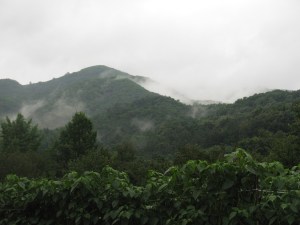
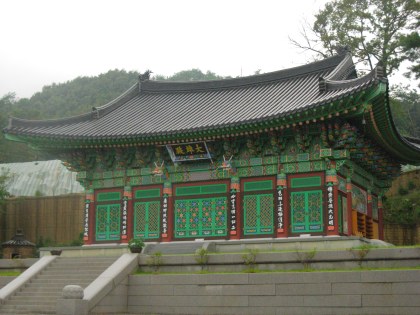
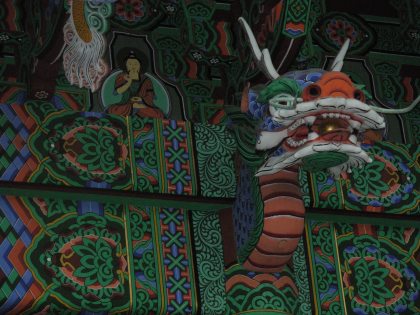 After hanging out under the awnings waiting for the rain to stop, we started walking up the hill. The regular road ended in a worn path through the woods and up the mountain. “I’m game if you are game,” we said to each other, and were off into the first place in Korea I have seen where we didn’t encounter a car, another person, or a house constructed from concrete for hours. The hillside had cemeteries, some older, and some quite new, every few hundred meters. Unlike most places in the US, where we write off slope as an improbable place for archaeological finds, all the cemeteries here on sometimes quite steep hillsides, with berms of earth built up around them.
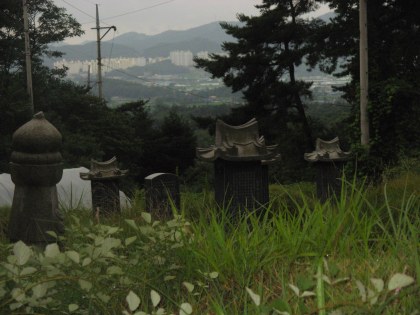
Cemetery
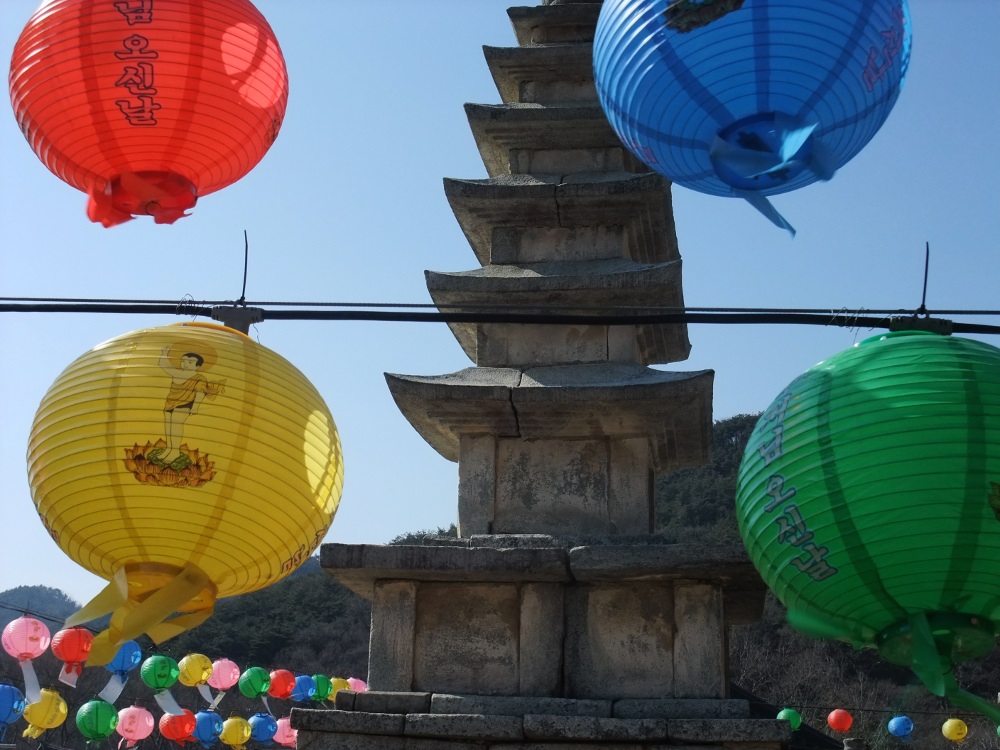
We walked up the mountain for a while and started to see the tell tale signs that there was a temple ahead. Primarily the plastic, painted lanterns strung through the trees.
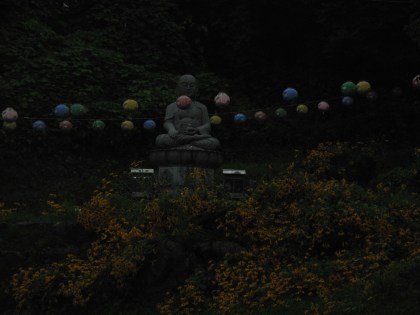
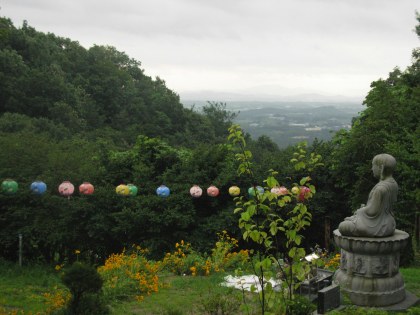
We came up around the temple, and came into the temple garden from the top. I noticed that one statue seemed out of place and not in keeping with the style or texture of most statues I have seen at temples. When I came around to the front, I could see that it was, indeed, a peeing fountain.
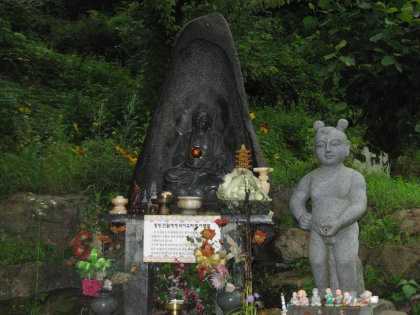
Peeing boy and Buddha.
We had a decision to make, keep heading up the mountain, or go back the way we came and call the taxi. We went for up. The weather was holding out, somehow we weren’t suffering from the exhaustion that overtakes me on even short subway rides to Seoul, and the excitement of travelling with someone who is agreeable to taking the unconventional path was too much fun. We took several paths around the mountain that ended in dead ends, waterfalls (unfortunately covered in trash, it seemed society’s mark had found its way onto the mountain), and one precarious river crossing where the road had washed out.
Making our way back down the other side we came to a peculiar coffee shop in the middle of nowhere. Called the Station Cafe, it came complete with the sounds of the proprietor playing jazz saxophone.
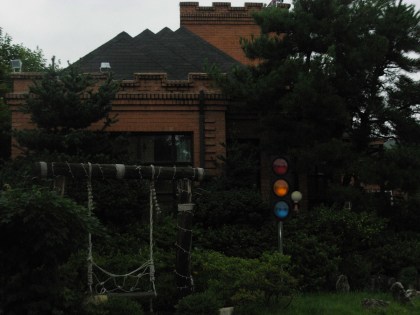
After a lovely cup of pine nut tea, we called the taxi to come take us back to the bus stop. When we pulled away from the coffee shop we could see that it was actually right next to the field we had been dropped off at. We had made a perfect circle around the mountain.
I am sunburned and exhausted from my trip down to Suwan today, but here are some pics.
Every Sunday at 2pm they do a traditional dance and cultural event. There was some great tea to be had as well. Look Carrie, it’s like fire dancing and drumming all in one! The streamers are actually attached to their hats and spin around to leave their hands free to play instruments. It was fun to watch.

An old percussive instrument.

A story etched in slate on the side of the building.

From the palace, I looked up the hill and saw what I’ve been looking for. Finally a Buddha!

I think this was a temple on the grounds of a school for young monks and people studying Confucianism.


Thanks to Celtic Librarian I just learned that the Smithsonian has podcasts that I can actually stream here! (Jumping up and down.)
I clicked on Silk Road Stories, and of course the featured podcast is about Korea. Some American and Korean musicians got together to have a Free Jazz concert. I used to play jazz in high school and college, but gave it up for bluer and grassier pastures. I’ve never particularly liked or understood free jazz, but this podcast was nice, beautiful and a lot simpler than free jazz I’ve heard in the past.
Another podcast I listed to was How Asanga Came to See the Future Buddha.
Off in search of news and entertainment not based in Korea or regarding swine flu.
Filed under: Books, Buddhism, Peace, War | Tags: Ani Pachen, Diane Ackerman, Harry Potter, Katherine Dunn, Namkhai Norbu, Philip Gourevitch, Shambala Sun, T.C. Boyle

It was a slow reading month, I didn’t quite make it to thirteen, so I added a couple of magazines. Lots of moving around, and very little sitting still.
 The Women – See my full review.
 The Zookeeper’s Wife — Fantastic hour long interview with Diane Ackerman about the novel.
We Wish to Inform You That Tomorrow We Will be Killed With Our Families by Philip Gourevitch
Short excerpts from Gourevitch at the Pen Festival of authors:
Terry Tempest Williams reads the article she wrote for Orion Magazine regarding her trip to Rwanda to help build a mosaic memorial.
 Geek Love Nominee for the National Book Award, this is a disturbing tale of a carnival family that attempts to engineer “freaks” with the use of drugs and poisons. All of their children are deformed in some way and we watch them grow up and manipulate each other. Interview with the author at Wired for Books.
 Sorrow Mountain A wonderful book about Ani Pachen’s childhood in rural Tibet, how her life changed after the invasion of the Chinese army, and her 21 years in prison. She tells her story without resentment, but in attempt to make the world understand how her spiritual practice sustained her. She recently died in Dharamsala, but here is a nice piece in her honor.

 Shambala Sun Magazine
For all the reading I’ve done, I’ve never bothered to pick up the Harry Potter series. I’m in Maine visiting my mother right now, and she had this inviting, hardcover, texturally interesting complete set sitting on her floor. I picked up the first one, and am half way through number 4 with no break at all. Highly entertaining, now I see what all the hype was about.
 Harry Potter and the Sorcerer’s Stone
 Harry Potter and the Chamber of Secrets
 Harry Potter and the Prisoner of Azkaban
 Harry Potter and the Goblet of Fire
Get the Thursday Thirteen code here!
The purpose of the meme is to get to know everyone who participates a little bit better every Thursday. Visiting fellow Thirteeners is encouraged! If you participate, leave the link to your Thirteen in others’ comments. It’s easy, and fun!
Previous months reading lists: January , February, March

The Places that Scare You by Pema Chodron
“For instance, even in the rock hardness of the aggression, we’ll generally find fear. Underneath the defensiveness is the brokenhearted, unshielded quality of bodhichitta. Rather than feel this tenderness, however, we tend to close down and protect against the discomfort.” pg. 56
Teaser Tuesdays is hosted by Should Be Reading.
 Portland, ME

Thanks to Book Bird Dog for giving this to me.
“This award acknowledges the values that every blogger shows in his or her effort to transmit cultural, ethical, literary, and personal values every day.”
Now for the silly part:
“The rules to follow are:
1) Accept the award, post it on your blog together with the name of the person who has granted the award and his or her blog link. 2) Pass the award to 15 other blogs that are worthy of this acknowledgment. Remember to contact the bloggers to let them know they have been chosen for this award.”
I think it is rather ridiculous to create an award, and then devalue it by making it a chain letter. I’m accepting it from Book Bird Dog because she stuck to just a few blogs that were really nice to read through, and I will do the same. I don’t even read 15 other blogs regularly, but here are a few that I really do enjoy.
Naked Without Books – Susan is an English instructor in S. Korea and has just participated in a 24-hour read-a-thon.
Lotus Reads – book reviews of a worldly nature.
While Sleepwalking – My dear friend has not blogged in a little while, but the past book reviews and European travels are well worth reading through.
Lessons from the Monk I Married – A great narrative of a woman who married a South Korean monk she befriended while working overseas.
The News Dissector – He dissects the news. A great blog with lots of information, video clips, and links.
Rebecca Hosking Travel Examiner – a great friend of mine who has been to over forty countries talks about them one country at a time.
 Ruby Ramblings